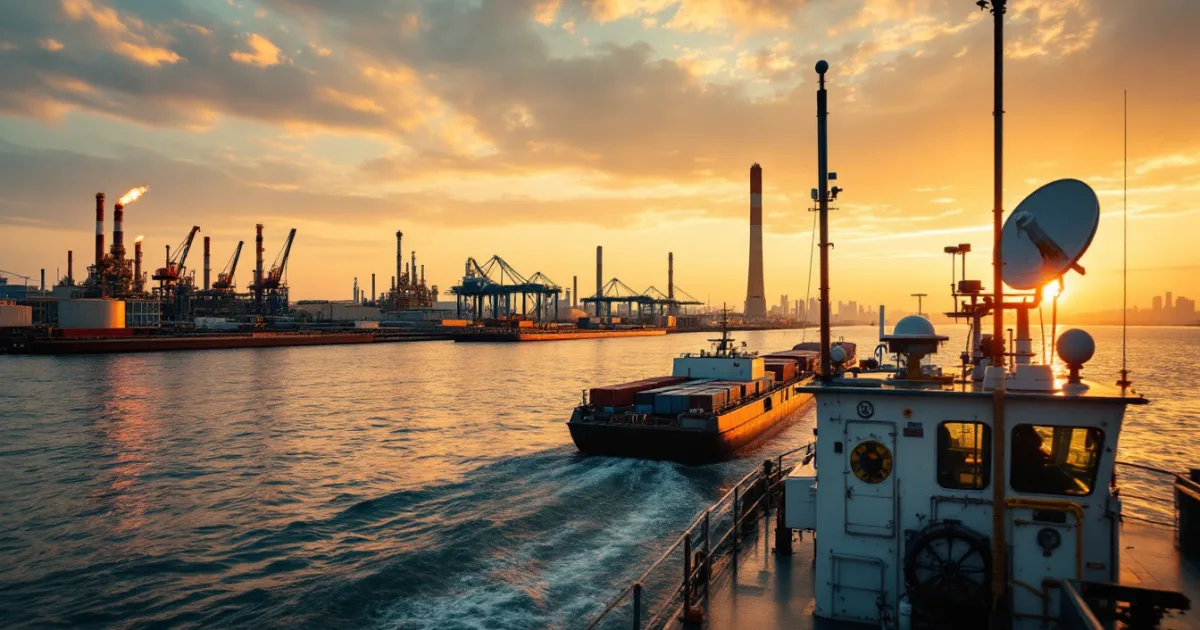
Vessel to shore connectivity is the data link between a working boat and the office ashore. On the Gulf Coast that means Starlink plus cellular, bonded through one router, with failover measured in seconds.
A towboat on the Houston Ship Channel needs a link that never fully drops, not one that is fast on a good day. The 2026 build is Starlink for bulk, cellular for the last few miles into a fleeting area, and a router that picks between them. Pick the wrong Starlink plan and you overpay 4x. The Coast Guard now has an opinion about that link.
Ask a port captain what breaks first when a boat loses signal. Not email. It is a barge sitting two hours past its window because nobody ashore could confirm the dock was clear. Which is why maritime IT support in Houston starts at the link and works inward.
Connectivity used to be a crew welfare line item. Somewhere in the last five years it turned into the thing dispatch, electronic logs, engine telemetry and a federal cybersecurity plan all ride on. Same antenna. Very different stakes.
Port Houston recorded 209,616 barge moves in 2025, per WorkBoat. Every one of them generated a document somebody ashore needed. When the link drops, the paperwork does not stop. It piles up, then arrives late, all at once, with errors in it.
What Vessel to Shore Connectivity Actually Means on a Working Boat
Vessel to shore connectivity is the two-way data path between a boat and the shoreside network it reports to. It carries dispatch orders, electronic logs, engine telemetry, crew traffic and remote support sessions over satellite, cellular or both. On the Gulf Coast, almost always both.
Three networks run on a modern towboat, not one. Satellite carries the bulk of it. Cellular carries the last few miles into a fleeting area or a terminal berth, where it is usually faster, always cheaper, and far less bothered by whatever the dish overhead can or cannot see above it. VHF and AIS carry safety traffic and sit outside this conversation entirely. Two different problems.
What rides the link has changed more than the link itself. Ten years ago a boat sent a position and a fuel number. Today it runs a tablet with electronic logs, a camera on the head of the tow, an engine package pushing data to the port engineer, a crew change roster, and a remote session any time the office needs the wheelhouse PC. Same hull. Roughly five times the traffic. None of it optional.
Why the Gulf Coast Breaks Connectivity Plans That Work Everywhere Else
The Gulf Coast breaks connectivity plans because one boat can run inland river, protected canal and open bay inside a single trip. Coverage rules, service plans and hardware ratings all change at those boundaries. The purchase order does not.
Start with geography. The Texas stretch of the Gulf Intracoastal Waterway moved 80 million tons in 2022 and supports about $77 billion a year in state economic activity, according to TxDOT. Most of that is protected water. A boat working Corpus to Orange never sees a swell. A boat crossing Galveston Bay for a lightering job does, and it crosses a service plan boundary on the way. Same fleet. Different rules.
Then the physical stuff, which nobody writes into the RFP. Antenna height fights bridge air draft. The Ship Channel is walled with refineries, cranes and steel structures that make cellular behave differently at 2pm than at 2am, and the upper GIWW reaches add tree canopy on top of that. Fleeting areas sit under bridges by design, because that is where the current is workable, which happens to be exactly where a satellite dish sees the least sky.
Then hurricane season shows up and rearranges all of it. Every year. Which makes this a disaster recovery conversation as much as a connectivity one.
Which Starlink Plan Does a Gulf Coast Boat Actually Need?
Most Gulf Coast boats need the Starlink Local plan, not the Global and Maritime plan. Local is sold for United States coverage. Global and Maritime is the one that covers international waters. On identical data, the gap is about 4x.
Here are the 2026 monthly rates, both columns, from an authorized Starlink reseller’s plan sheet. Terminal options and plan detail sit on Starlink’s own maritime page. Same dish. Same data. Different permission.
| Monthly priority data | Starlink Local (US coverage) | Starlink Global and Maritime | Multiple |
|---|---|---|---|
| 50 GB | $80 | $275 | 3.4x |
| 500 GB | $155 | $650 | 4.2x |
| 1 TB | $280 | $1,150 | 4.1x |
| 2 TB | $530 | $2,150 | 4.1x |
| 5 TB | $1,290 | $5,150 | 4.0x |
| Overage per GB | $0.50 | $1.50 | 3.0x |
Stare at the 500 GB row. $155 against $650. That is $5,940 a year on one boat, and across a 12-boat fleet it is $71,280 that never made it onto a budget line, because somebody picked one plan for every hull and then moved on to the next problem. It just accumulated.
Now the honest part. Where the boundary falls for a specific route is a question for Starlink, in writing, route by route. Not for a blog post, and not for your dispatcher’s best guess. What we can tell you is that almost nobody asks, and the default behavior across the fleets we walk into is to buy the expensive plan for every hull because one hull needed it once. Ask.
Hardware deserves a second look while you are in there. The Starlink Performance terminal is rated IP69K, runs from -40°F to 140°F and has a 140 degree field of view. The Standard dish is IP67, 110 degrees, operational to 60 mph and up. On a wheelhouse roof in a Houston August, with salt spray and a squall line coming across the bay, that stops being a spec sheet argument. It becomes a maintenance schedule.
What Rides the Link, and How Much of a Dropout Each Thing Survives
Not every workload cares about a 30-second gap. Sorting the ones that do from the ones that do not is most of the design work. The ranges below are what we see across Gulf Coast boats we support rather than published figures, so treat them as a starting point. Measure yours.
| Workload | Typical data per boat, monthly | Survives a 30-second dropout? |
|---|---|---|
| Dispatch, email, document exchange | 5 to 15 GB | Yes |
| Electronic logs and TSMS records | Under 2 GB | Yes, it syncs later |
| Engine and fuel telemetry | 1 to 5 GB | Mostly, the gap shows in the trend |
| Live camera on the head of the tow | 60 to 300 GB | No |
| Remote session to the wheelhouse PC | 1 to 3 GB | No, the session ends |
| Crew personal use | 100 GB and up | Yes, until it eats the priority bucket |
Read the top row and the bottom row together. Crew traffic runs 6 to 20 times the size of everything the business actually needs to move, and it is also the one workload on that boat with the highest tolerance for a bad minute. That is the entire argument for traffic shaping, and it is why the router ends up mattering more than the dish. Shape it.
How Should the Onboard Network Be Built?
A working build is one router with two or three WAN inputs, a satellite dish, at least one cellular modem on a carrier that genuinely covers your run, and a policy that decides which traffic goes where. Failover has to be automatic. Under a second.
Three shapes show up in practice, and the right one is a function of what you carry, not what you can spend.
- Satellite only, single link. Best for a day boat that works one harbor and whose worst outage costs a late email. Cheap. Fine. Stop reading.
- Satellite plus cellular failover is the default for line-haul work on the GIWW and the rivers. The router watches both paths, holds the session open, and moves traffic the moment one of them degrades. Peplink SpeedFusion and Cradlepoint both handle this well.
- Bonded, with both links carrying at once, is what you need when a live camera feed or an open OT session is part of the job. A one-second gap ends that session and somebody has to call the boat to get it restarted.
One thing gets skipped on almost every build we inherit. Segment the boat. Crew Wi-Fi, business traffic and anything touching engine or steering systems belong on separate VLANs with written rules between them. Not optional now. The next section explains why.
What the Coast Guard Now Requires of That Link
33 CFR Part 101 Subpart F sets rules for the boat network now, not just the office network. Multifactor authentication on remotely accessible OT. A documented network map. Logged connections between IT and OT.
- Personnel training under 33 CFR 101.650 was due January 12, 2026, and repeats every year after that.
- A Cybersecurity Assessment has to be completed no later than July 16, 2027, then annually.
- Cybersecurity Plans go to the Coast Guard for review and approval no later than July 16, 2027 under 33 CFR 101.655.
- Multifactor authentication is required on password-protected IT and on remotely accessible OT systems. Where it is not technically feasible you document compensating controls instead.
- Penetration testing is tied to plan renewal, with a certifying letter and every vulnerability found filed into the security assessment.
- Plan audits run annually, beginning no later than 1 year from the initial date of approval.
Read that list as a network specification, because that is what it is. A network map. Encryption where technically feasible. IT to OT connections logged and monitored. MFA on every remote access path. Our network security services page covers how those controls actually get built and kept alive. What this post adds is that half of them now live on a moving boat. Under a satellite dish.
So who does it reach? Subpart F applies to U.S.-flagged vessels, facilities and OCS facilities that already carry a security plan under 33 CFR Parts 104, 105 or 106. Plenty of inland barge lines sit outside that entirely. Their customers do not. The requirement arrives anyway, through the terminal contract, usually as a questionnaire with a two-week turnaround and a signature block on the last page. Maritime cyber incidents rose 103% in 2025 according to the CYTUR 2026 threat white paper. Those questionnaires will get longer. And the facility side carries a second set of USCG maritime cyber rules Texas operators keep missing.
Where These Builds Actually Fail
None of the failures we get called about are exotic. They are boring, and they repeat.
- The dish sees sky at the dock. Somebody mounted it during a yard period with a crane parked between it and half the horizon, tested it tied up, and signed off.
- Nobody owns the SIM. When the cellular line dies, working out who is allowed to call the carrier takes 20 minutes and three phone calls.
- $0.50 per GB reads like nothing on the 3rd of the month. It reads like a real number on the 24th.
- A shared password on the engine monitoring portal. Every port engineer knows it. So does the one who left in 2023.
- The router logs nothing, so when the office says the link was down for 40 minutes and the captain says it was not, there is no third answer and the whole thing quietly turns into an argument about people instead of an argument about packets.
- Two Starlink accounts billed against one hull, found during an audit that had been looking for something else entirely.
Bias disclosed. We get paid to fix this. If your operation is 3 boats that never leave one harbor and your worst outage costs a late email, you do not need a bonded architecture, and we will say that on the call rather than quote you one. Where it does start to matter is the first time a customer terminal asks you for evidence, or the first time a loaded tow sits waiting on a document that could not get off the boat. That is the line. If you are shopping this out, our Houston Ship Channel provider comparison lays out who else is in the market.
A 30-Day Plan to Get a Fleet Link Under Control
Four weeks, in order, and none of it needs a capital request to start. Order matters here more than speed does.
- Week 1. Inventory every hull. Dish model, plan tier, carrier, who owns the SIM, router make, and actual monthly data used. Half of what comes back will surprise somebody.
- Week 2. Pull 90 days of usage against plan for each boat and split business traffic from crew traffic. That split is where the money is hiding.
- Week 3. Map each vessel’s real route against Starlink plan coverage and get the answer in writing from the vendor, per hull. Right-size down as well as up.
- Week 4. Build the network map Subpart F asks for, list every remote access path that reaches an OT system, and put MFA on the ones missing it. You now have the beginning of an assessment instead of an empty template.
Weeks 1 through 3 usually pay for week 4. On a mid-size fleet, plan right-sizing alone tends to cover the security work with room left over, which is a much easier conversation to have with a CFO than a compliance one. For the shoreside per-seat picture, what IT costs a Texas freight brokerage or 3PL runs the same math on the office half of the operation.
Where to Start If the Link Is the Problem
Two things carry most of the value here. Plan tier and vessel route are one decision, not two, and pulling them apart is what makes connectivity look expensive. And the link now sits inside the scope of a federal cybersecurity rule, which makes the router on that boat a compliance artifact whether or not anybody has told your port captain yet. Both are cheap to check.
Uprite is a Texas managed IT and cybersecurity provider, in business since 1999, MSP 501 recognized 7 years running and SOC 2 Type 1 attested, working with maritime and logistics operators from the Ship Channel out to the inland rivers. We publish $138 per user per month for this work with a 120-day satisfaction guarantee, and we treat the boat side and the shore side as one network because that is what they are. Our statewide maritime and logistics practice covers the rest of the stack, and our cybersecurity team owns the Subpart F work. If you are looking at a fleet with mismatched plans and a 2027 deadline, start with the inventory, then speak to a maritime IT expert and we will walk it hull by hull with you.
What Port Captains and Fleet Managers Ask Us
Can a towboat run on cellular alone up the Houston Ship Channel?
For short harbor runs, sometimes. The channel has good cellular coverage and it beats satellite on both cost and latency. The problem is single-carrier risk. Coverage thins in stretches, it thins differently on each carrier, and a boat with one modem has one point of failure that nobody ashore can see until a call comes in from the wheelhouse. Fine for a day boat. Not for line-haul.
Does Starlink actually work in a fleeting area under a bridge?
Not reliably, no. A dish needs a clear view of a wide slice of sky and a bridge deck removes a chunk of it. That is the single best argument for putting a cellular modem in the same cabinet, because fleeting areas and berths are exactly where cellular is strongest. The two technologies fail in opposite places. Run both.
How much data does one boat really burn in a month?
5 to 15 GB of business traffic. Crew use then lands on top of it and the number stops being predictable. We have seen boats at 40 GB and boats past 400 GB with identical operations, and the only variable was whether anyone had put crew Wi-Fi on its own segment with a cap on it. Measure for 60 days before you buy a plan tier. Guessing costs more than measuring.
We are a barge line, not a facility. Does the Coast Guard cyber rule touch us?
Directly, only if you hold a security plan under 33 CFR Parts 104, 105 or 106. Indirectly, almost certainly. Terminals and facilities that are covered push the requirements down into their vendor and carrier agreements, because that is how they evidence their own compliance, and a questionnaire with a two-week turnaround is how it usually shows up on your desk.
Who is supposed to pay for the crew streaming?
Wrong question, slightly. Nobody much cares who pays for 200 GB of video. What matters is that it does not sit in the same priority bucket as dispatch traffic, because the day it does is the day a bill of lading waits behind somebody’s movie night. Split it at the router. Cap it. Then the payment question gets small enough to answer however you like.
What breaks first in a hurricane, the boat or the office?
The office. Almost always the office. Boats get moved, crews get relieved, and the satellite link keeps working because it does not depend on anything onshore staying powered. The shore side is what loses utility power, loses circuits, and loses the file server everybody on the water was syncing to. Which is uncomfortable, because most of the money in these projects gets spent on the vessel.