
A Fort Worth company should hire an IT consultant for work with a finish line, like an ERP selection or a CMMC gap assessment, and a vCIO for duties that repeat, like yearly SPRS affirmations, renewals, and budgets.
I lead the vCIO team at Uprite, and this post supports our main page on IT consulting in Fort Worth. Here the question tends to come up in a specific way. A machine shop in Haltom City or a parts supplier near AllianceTexas gets a cybersecurity clause from a prime contractor, hires someone to read it, and then has to decide who looks after the result next year. This post explains how the 2 roles differ, what the local labor data says about each, how the federal CMMC rules create work that never really ends, what each option costs over 3 years, and when I’d point you toward an independent consultant instead of us.
Hire a consultant when you can write down the finished product before the work starts, such as a network design for a new building, a software selection, or a one-time CMMC gap assessment. Hire a vCIO when the work comes back on a calendar, such as a Level 1 self-assessment every year, an affirmation in SPRS every year, POA&M items due within 180 days, and the budget and renewals that follow. Many firms need both.
What separates a vCIO from an IT consultant?
An IT consultant sells a defined result, and the engagement is over once that result is delivered and accepted. A vCIO, short for virtual chief information officer, sells continuity. That person keeps the technology plan, the budget, and the vendor calendar for a company on a part-time basis and is still there for the next decision.
The difference shows up most clearly in what each one is responsible for on a Monday morning 14 months after the first meeting.
| Point of comparison | IT consultant | vCIO |
|---|---|---|
| Unit of work | A statement of work | A standing calendar of reviews |
| End point | Final deliverable accepted | None while the agreement runs |
| Memory of past decisions | Whatever was written in the report | Carried from one quarter to the next |
| Role in a prime’s security questionnaire | Helps if hired for that round | Prepares the answers each cycle |
| Typical billing | Hourly or a fixed fee | Monthly, or bundled into managed IT |
| Best measure of success | Quality of the deliverable | Fewer surprises in the budget |
None of this makes one role better. A good consultant is often sharper on a narrow problem than a generalist vCIO. The question is whether your next 3 problems are separate projects or chapters of the same story.
Why is the Fort Worth consulting bench thinner than Dallas?
Fort Worth has fewer IT consulting firms, and the ones it has are small. The BLS Quarterly Census of Employment and Wages for 2025 counted 670 private computer systems design services establishments in Tarrant County, employing 6,070 people. Dallas County had 2,133 establishments employing 34,782 in the same industry. That works out to about 9 workers per Tarrant establishment against about 16 in Dallas County.
Smaller doesn’t mean cheaper. Average annual pay in that Tarrant industry was $129,913, a little above Dallas County’s $126,731. Management consulting looks similar. Tarrant had 802 private establishments in administrative management consulting with 3,458 employees, or roughly 4 people each.
For a buyer, those numbers raise a practical question. If your consultant works in a 4 person firm, who answers the phone during their next engagement? That isn’t a reason to avoid small firms. Some very good specialists work alone. It does mean you should ask who covers for them, and what written records you keep if they become unavailable. We compared 8 of them in our ranking of the best IT consulting firms in Fort Worth.
How many Tarrant County companies sit in the vCIO range?
The Census Bureau’s County Business Patterns for 2023 lists 47,656 employer establishments in Tarrant County. Of those, 39,411 had fewer than 20 employees. Another 5,098 had 20 to 49, 1,793 had 50 to 99, and 947 had 100 to 249, for a total of 7,838 establishments between 20 and 249 people.
That group of about 7,800 is where this choice usually gets made. These companies run real systems and sign real contracts, yet few of them can justify a full-time technology executive. Keep in mind that the Census counts locations, not companies, so a contractor with yards in Fort Worth and Mansfield shows up twice. The overall size pattern still holds.
Which Fort Worth decisions belong to each role?
Sorting by the decision works better than sorting by job title. These 9 examples come up often for companies around Tarrant County.
| Decision | Better fit | Why |
|---|---|---|
| Wiring and network design for a new building near AllianceTexas | IT consultant | The work is complete once the building opens |
| Picking an ERP or shop-floor scheduling system | IT consultant | A selection ends with a signed contract |
| A first CMMC Level 2 gap assessment | IT consultant | It produces a scored report and a list of gaps |
| Independent review before buying another company | IT consultant | The reviewer shouldn’t benefit from the outcome |
| Closing POA&M items before the 180-day limit | vCIO | The fixes have to be tracked, funded, and proven |
| The yearly Level 1 self-assessment and SPRS affirmation | vCIO | The same evidence gets refreshed every 12 months |
| A 3-year plan for servers, firewalls, and shop-floor PCs | vCIO | Replacement dates fall in different budget years |
| Renewals for Microsoft 365, phones, and the ERP license | vCIO | Each one renews on its own date |
| Answering the cyber insurance application each year | vCIO | The answers have to match last year and the real setup |
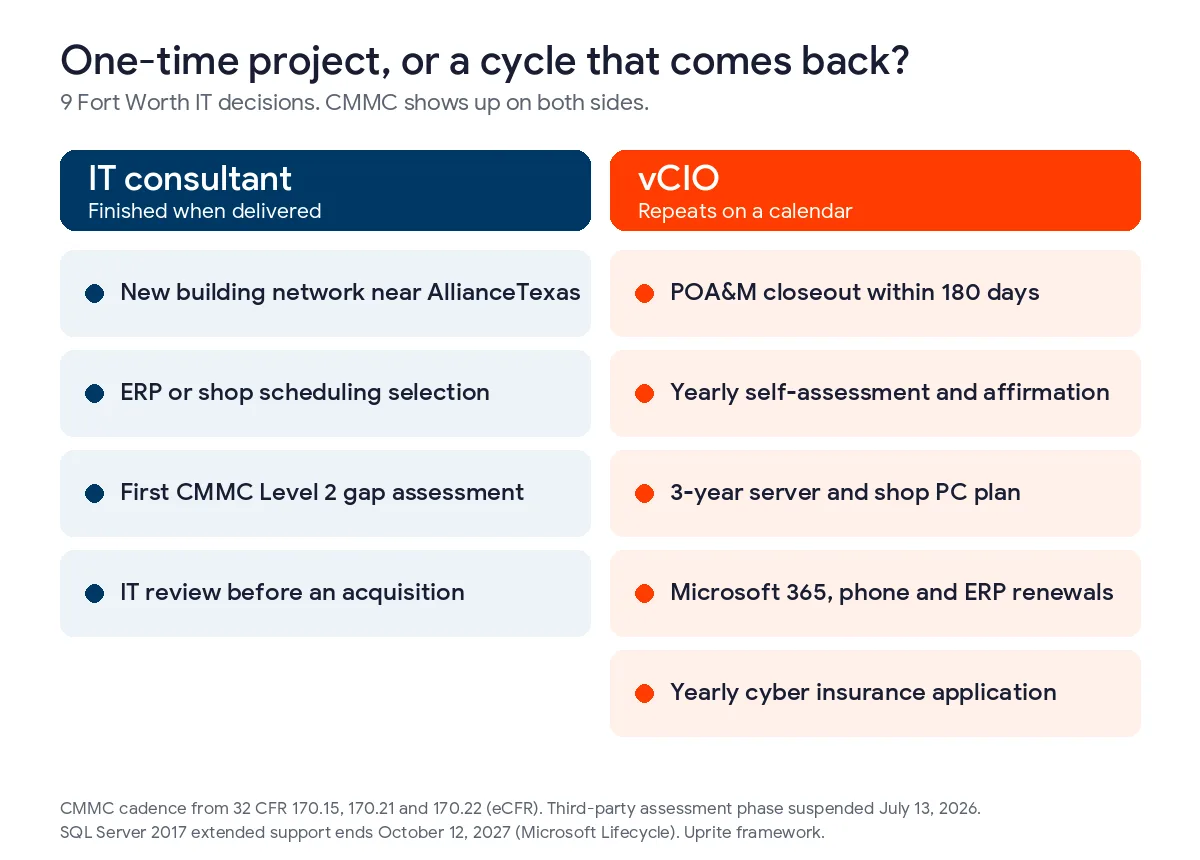
Notice that the CMMC rows land on both sides. The first assessment is a project. Everything after it is a cycle, and that’s the part companies tend to leave without an owner.
What do the CMMC rules show about the difference?
The federal CMMC program spells out how often the work repeats. Under 32 CFR 170.15, a company holding Level 1 status has to run a self-assessment every year and post the results in SPRS. Under section 170.16, a Level 2 self-assessment has to be repeated every 3 years.
On top of that, section 170.22 requires an affirmation of continuing compliance after every assessment and every year after that. The rule says it comes from an Affirming Official, defined as a senior level representative from within the company. An outside consultant can’t sign it for you, and neither can your vCIO. What a vCIO can do is make sure the person signing has current evidence in front of them.
Deadlines also follow the assessment. If a Level 2 assessment ends with open items on a plan of action and milestones, section 170.21 gives the company 180 days from the conditional status date to close them. If they aren’t closed by then, the conditional status expires.
The Pentagon suspended the third-party assessment phase on July 13, 2026. The self-assessment phase that started on November 10, 2025 still applies, and so does the older contract clause DFARS 252.204-7012, which requires reporting a cyber incident to the DoD within 72 hours of discovery. A 72-hour clock needs a plan that someone already owns. You can’t hire a consultant fast enough after the fact.
Our post on CMMC for Fort Worth aerospace suppliers covers the supplier side in more detail, including how many Tarrant firms hold Defense subcontracts.
How does an end-of-support date play out?
Microsoft’s lifecycle page for SQL Server 2017 shows extended support ending on October 12, 2027. Plenty of accounting, ERP, and shop scheduling systems run on a SQL Server database underneath, and owners often don’t know which version.
Take a hypothetical 60 person fabricator in Haltom City whose ERP database sits on SQL Server 2017. A consultant could scope the upgrade well, and that’s a reasonable job to hand out. The bigger issue is timing. If the company plans its budget in the fall, the 2027 budget is the last one that can pay for the work before support ends. A vCIO who keeps a lifecycle list would have flagged that date during budget season. Without that list, the upgrade usually turns up when the ERP vendor stops supporting the old version, and then it’s a rush job.
What does each option cost a Fort Worth company over 3 years?
CMMC runs on a 3-year cycle, so I compared the options over 3 years instead of 1.
For consultant rates I used the GSA CALC labor rate tool, one of the few public sources of negotiated hourly ceilings. On November 18, 2026 it held 1,018 rates for IT consultant job titles without a clearance requirement, from 339 vendors. The median was $149.62 an hour and the middle half ran from $124.43 to $182.89. CIO-level titles were scarce, with 11 rates from 10 vendors and a median of $245.19.
For a full-time hire, the BLS doesn’t publish a separate Fort Worth figure. The Dallas-Fort Worth metro mean for computer and information systems managers was $185,720 in May 2025. Private employers add about 43% for benefits and payroll taxes according to the June 2026 Employer Costs for Employee Compensation release, which brings the total to about $265,600 a year.
| Option | Basis | First year | 3 years |
|---|---|---|---|
| Full-time CIO | $185,720 mean plus about 43% | About $265,600 | About $796,700 |
| Consultant, one assessment | 40 to 120 hours at $149.62 | About $6,000 to $18,000 | Same, if never called back |
| Consultant, called back | 90 hours a year at $149.62 | About $13,500 | About $40,400 |
| Standalone vCIO | $3,000 to $10,000 a month | $36,000 to $120,000 | $108,000 to $360,000 |
| vCIO in managed IT | Included in the per-user rate | No separate line | No separate line |
The hour counts are my own planning figures, not survey data. The 90 hour row assumes 3 return visits a year of about 30 hours each. The $3,000 to $10,000 range is what other providers typically charge for a standalone vCIO. At the $245.19 CIO-level median, $3,000 buys about 12 hours a month and $10,000 buys about 41.
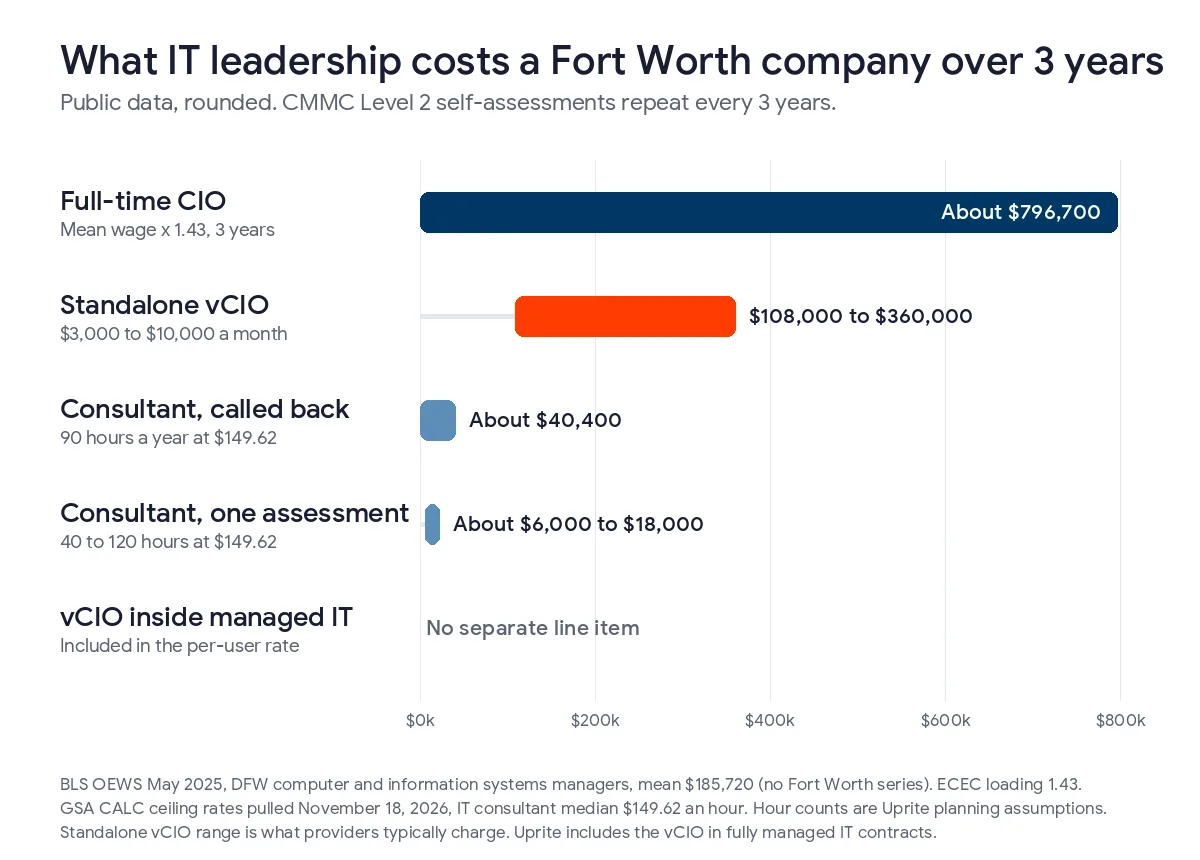
The called-back consultant looks cheap next to a standalone vCIO. The catch is what happens between visits. Each return trip starts with catching up on what changed, and nobody is watching the affirmation date or the POA&M clock in the meantime.
When is an independent consultant the better call?
I run a vCIO practice inside a managed IT company, so weigh my view with that in mind. There are still 4 cases where I’d tell a Fort Worth owner to hire someone independent.
- You want a second opinion on a proposal from your current IT provider, including one from us.
- You want the person scoring your CMMC controls to be someone who didn’t set them up.
- You have a capable IT manager and need one specialist for a few weeks, such as a wireless design for a large warehouse.
- You’re buying a company and need its IT reviewed before closing by someone with no stake in the deal.
A vCIO at a managed provider has some interest in what you buy, whether that’s a firewall brand or a backup service. A good one says so plainly and shows you the alternatives. An independent consultant avoids that conflict from the start.
The independence argument has a limit, though. If you’ve brought back the same consultant 3 times in a year for problems that connect, the arrangement has quietly become a vCIO role without the accountability.
What should you get back before a consultant’s final invoice?
Whichever way you go, the handover decides whether the next person starts from scratch. Ask for these before you pay the last bill.
- The full report in an editable format, not only a PDF
- Network diagrams and an inventory of hardware, software, and licenses
- Admin accounts moved into a password vault your company controls
- For CMMC work, the system security plan and the POA&M with owners and dates
- A list of every renewal and end-of-support date the consultant found

That last item is the bridge between the 2 roles. A consultant who hands over a dated list has done the vCIO’s first job for them. Our guide to what a vCIO does in Texas shows what happens to that list afterward, and our explainer on whether you need a vCIO at all compares the role with a full-time CIO.
How does Uprite handle vCIO work for Fort Worth companies?
Every fully managed client gets a named vCIO, and across the Metroplex that’s usually me or Jeremy Pruitt. The role is included in the per-user fee, not billed as a separate line. Quarterly strategy sessions happen at your site or at our Dallas office on Alpha Road, roughly 30 minutes from downtown Fort Worth. Details are on our vCIO services in Fort Worth page.
If a managed agreement is too big a first step, our IT consulting services start with a fixed-fee assessment that typically takes 4 to 6 weeks. Companies that already have IT staff can add planning through co-managed IT in Fort Worth. Manufacturers can see how this fits shop-floor systems on our manufacturing IT services in Fort Worth page, and the full service is on our managed IT services in Fort Worth page.
What Fort Worth owners ask about vCIOs and consultants
Can an IT consultant sign our CMMC affirmation?
No. Section 170.22 says the affirmation comes from a senior level representative within your company, so it has to be someone on your side. A consultant or vCIO can prepare the evidence, but the signature and the responsibility stay with your executive.
Does a vCIO need to be based in Fort Worth?
Not necessarily, but they should be close enough to show up. Most vCIO work happens in budget meetings and vendor calls. A walk through the shop floor or the server closet a few times a year still catches things a video call misses.
How many hours a month does a vCIO spend on one company?
For a company with 20 to 249 employees, roughly 12 to 40 hours, depending on how much is changing. Months with a budget build, an insurance renewal, or a CMMC affirmation run heavier, and quiet months can be a single review call.
Should the consultant who runs our gap assessment also fix the gaps?
For a self-assessment it’s allowed, and it can save time, since they already know the findings. The tradeoff is objectivity. Some companies prefer one firm to assess and another to fix, then have the assessor confirm the fixes.
What happens to the roadmap after a consulting engagement ends?
Unless someone is assigned to it, the roadmap usually stops moving within a few months. Name an internal owner on the day it’s delivered, give that person a quarterly review date, and put the first 3 items into the current budget.
Is a vCIO worth it for a 15 person company?
Often not as a standalone service. A company that size may be better served by a short consulting project and solid managed support. That changes once defense contract clauses, insurance questionnaires, or multiple renewal dates start piling up.
Got a CMMC clause, a software decision, or a stack of renewals on your desk? Send us the list and we’ll tell you which items are one-time projects and which need an owner. Our average response time is 5 minutes.
Talk to a vCIO