
A headquarters relocation IT plan for Collin County should order the internet circuits first, settle phone numbers and 911 addresses second, and leave desks for last, because carriers and federal rules set the slowest clocks. Laptops are the easy part. They always are.
This guide is for companies moving a head office from another state into Plano, Frisco, or somewhere else in the county. If you already know you want help on the ground, our page on managed IT services in Collin County covers dispatch across the county’s main cities, so here we can stick to the move itself, meaning what crosses a state line with you, what stays behind, and the order we’d do the work in. Nothing generic. A same-city move is a smaller job. Our general IT checklist for moving into a new office handles that one well.
An out-of-state headquarters move changes 5 things a local move never touches. Your office phone numbers may not be allowed to follow you. Every desk phone needs a new 911 address with the suite and floor. Your public IP addresses change, which breaks sign-in rules and vendor allowlists. Schedules built for another time zone drift. And your employees’ records become Texas residents’ records under Texas breach law.
What Makes an Out-of-State Headquarters Move Different?
An out-of-state headquarters move is different because some of your IT is tied to a place, not a building. Phone numbers, emergency calling records, public IP addresses, time zones, and state privacy law all change at the border. A local move keeps every one of them. An interstate move resets them all at once.
Generic moving lists skip this. They’re written for a team going 3 miles across town, where the carrier, the area code, and the state attorney general all stay exactly the same and nobody has to think about any of them. Not here. When the move is 1,400 miles, carrying computers is the simple bit. The real work is paperwork. Phone carriers, mostly. Plus a few federal rules most people have never read.
| What changes at the state line | Why it changes | Who sets the clock | When to start |
|---|---|---|---|
| Internet circuits | New building, new carrier order | The carrier, 30+ business days for buildings without fiber | At lease signing |
| Main and direct phone numbers | Porting is defined at the same location | Your current and new phone carriers | Before you pick a phone system |
| 911 location on every phone | Federal dispatchable location rule | Whoever manages the phone system | 2 to 3 weeks before move week |
| Public IP addresses | New circuit, new addresses | Your own admins and every vendor that allowlists you | As soon as the carrier assigns them |
| Time zone on schedules | Jobs pinned to the old zone | Your IT team or provider | The week before cutover |
| Breach notice and security law | Staff become Texas residents | Texas Business and Commerce Code | Before the first employee relocates |
Who Is Moving Headquarters to North Texas?
Mostly California companies. That’s what our own count says, anyway. The Dallas Regional Chamber’s 2026 Dallas Regional Economic Development Guide prints a map of headquarters relocations to Dallas-Fort Worth. We counted every name on it. By hand. The total was 147 companies from 25 other states, plus 32 international firms and 12 from elsewhere in Texas.
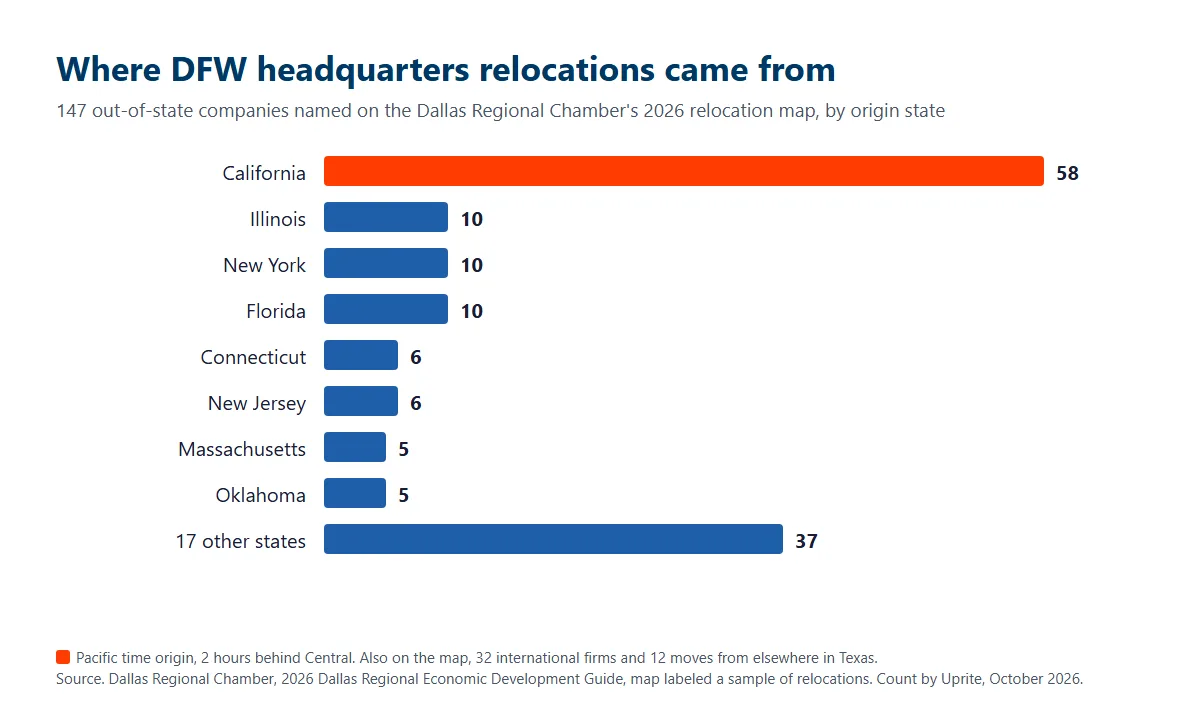
California alone accounts for 58 of the 147 out-of-state names. That’s 39.5%. Illinois, New York, and Florida follow with 10 each, and Connecticut and New Jersey have 6 apiece. The chamber calls the map a sample of relocations rather than a complete count, so read the shares as a rough picture of where these companies come from and not as a census of every move. Still, the pattern is clear. Two of the better-known names on it are Toyota Motor North America, from the California list, and PGA of America, from the Florida list, and today both run their headquarters in the area, Toyota in Plano and PGA of America in Frisco.
Why does the origin matter to IT? Time zones. A West Coast company jumps 2 hours ahead the day it lands in Plano. Sounds minor. It isn’t. Backup windows, patch reboots, phone system business hours, and scheduled reports were all built around a Pacific workday, and nobody remembers that until something fires at the wrong moment in front of the whole office. Picture a patch reboot pinned to 6 a.m. Pacific. In Plano that’s 8 a.m. Central, right as people sit down. Fix the schedules before cutover. Not after the first bad Monday.
How Far Ahead Should You Order Internet for a Plano or Frisco Office?
Order it the week you sign the lease. Seriously. Carriers publish their own install windows, and those windows are longer than most move schedules assume. AT&T’s Dedicated Internet product brief lists fiber-ready locations at as little as 10 to 20 business days. Buildings that aren’t fiber ready take 30 business days or more, which works out to about 6 calendar weeks at the short end, and that’s before any delay in the riser, the landlord’s paperwork, or a permit for new conduit. Chase the order weekly.

| Building status | AT&T published install window | What we’d plan for |
|---|---|---|
| Fiber already lit to the building | As little as 10 to 20 business days | Order at lease signing anyway, the window is a floor |
| No fiber in the building yet | 30 business days or more | Treat it as the longest task in the whole move |
| Second carrier for backup | Its own separate order and window | Order both on the same day so neither waits on the other |
Before you sign, look the address up on the FCC National Broadband Map. It’s free. The map shows which providers report service at that exact location. Then ask the landlord a blunter question. Which carriers have equipment in the telecom room today? The map tells you who claims coverage. The landlord tells you who’s already in the room. Those can be different answers. Check both.
One more detail from that AT&T brief. The service includes up to 5 static IP addresses. Get yours in writing. You’ll need them weeks before move-in for the sign-in rules and vendor allowlists covered below, and waiting until the circuit goes live on the Friday before the move leaves no room for a vendor that takes a week to update its list.
What Should a Pre-Move IT Assessment Cover for a Headquarters Move?
A pre-move assessment for an interstate headquarters move should list everything tied to the old location and give each item an owner and a date, so nothing location-bound is left for the movers to discover. It isn’t a hardware count. That part is quick. The location-bound list is slower, and it’s the one that breaks things on day 1.
- List every phone number the company owns, including fax lines, toll-free numbers, and direct dials.
- Find every system that trusts your office IP address, starting with Microsoft 365 sign-in rules.
- Record each phone’s 911 location, softphones included, since laptops travel.
- Flag old-time-zone schedules.
- Choose what ships to Texas and what gets bought there.
- Name staff staying behind.
- Confirm the security installer.
Phone numbers may not follow you
This one surprises people. Federal law defines number portability as keeping your number at the same location when you switch carriers. Move that location 1,400 miles and a traditional carrier can say no. Cloud phone platforms are often more flexible about out-of-area numbers. Results vary by carrier. Ask first. Your main number is printed on every invoice, website, and business card you own, so losing it by surprise in the last week of a move is the kind of problem that takes months of mail forwarding and customer confusion to clean up.
Timing is less of a worry. Under 47 CFR 52.35, a simple port has to finish within 1 business day and a non-simple one within 4, unless someone asks for longer, and ports involving a VoIP provider fall under the same clock. The port is quick. The question of whether the number can move at all is what eats time, so settle it before you sign a phone contract.
Every phone needs a new 911 address
Federal rules under 47 CFR 9.16 require a multi-line phone system to let anyone dial 911 directly, with no 9 first, even if staff dial 9 for every other outside call. The same rule calls for a notice to a central spot, like a front desk or security team, when someone does, as long as the system can send one without an upgrade. On systems installed after February 16, 2020, fixed desk phones have had to send a dispatchable location since January 6, 2021. That means a validated street address plus the suite or floor. Non-fixed and off-site devices followed a year later.
Here’s the catch. Every phone record in your old system still points at your old building, and a phone that was unplugged in one state and plugged back in another can keep sending that old address unless a person goes into the system and changes it. We’d load the new suite and floor for every device before move week. Then check where the 911 notice goes. It should reach someone in Plano. Not an inbox back home.
Your sign-in rules are tied to an IP address
Plenty of companies tell Microsoft 365 to trust the office network. Microsoft’s own page on Conditional Access named locations says these lists can include your headquarters network ranges. New building, new circuit, new addresses. Every one changes. Payroll portals, bank platforms, and some line-of-business apps keep allowlists too. Miss one and your first morning in Frisco looks like a security incident to that system.
The fix is boring. Good. Add the new static IPs to every list the week before cutover, right alongside the old ones. Keep both for a month. Then remove the old ones on a date you’ve written down.
Badge readers and cameras need a licensed installer
Texas treats most of them as alarm systems. The definition in Occupations Code Chapter 1702 covers computer-based door access control and camera systems that record images, and installing or servicing them generally takes a company licensed under that chapter by the Texas Department of Public Safety. It’s easy to miss. General contractors often sub out the low-voltage work. Ask for the installer’s license number before the walls close.
What Does Day 1 Cutover Look Like?
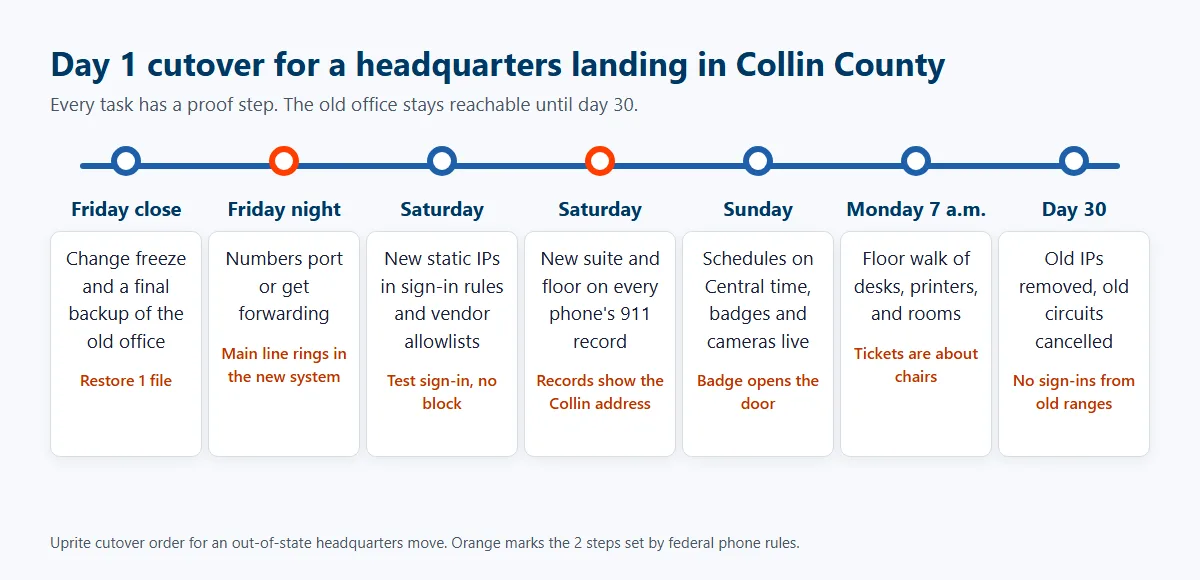
Day 1 should feel dull. People badge in. They sit down and work. Everything interesting happened over the weekend, and the old office can still take a call if something goes wrong. Here’s the order we’d run it in for a company landing in Plano or Frisco from out of state.
| When | Task | Proof it worked |
|---|---|---|
| Friday after close | Change freeze starts and a final backup runs on anything still on site in the old office | One file restored from that backup |
| Friday night | Numbers that can port go to the new phone system, forwarding goes on the ones that can’t | The main number, called from a cell phone, rings in the new system |
| Saturday | New static IPs confirmed in sign-in rules and vendor allowlists, old ones left in place | A test account signs in from the new network with no block |
| Saturday | Phones registered with the new suite and floor as their 911 location | Each phone record shows the Collin County address |
| Sunday | Schedules moved to Central time, badge readers and cameras live | A badge opens the door and the recorder shows today’s footage |
| Monday, 7 a.m. | Floor walk of every desk, printer, and conference room | Tickets by 10 a.m. are about chairs, not logins |
| Day 30 | Old IP ranges removed and old circuits cancelled, forwarded numbers kept until customers have the new ones | No sign-ins from the old ranges in the past week |
Our honest take on that last row? Don’t cancel the old circuits early. It’s tempting, since it saves a month of service on a building you’ve already left, but a month of overlap costs far less than a week with no fallback while the new building shakes out its first real problems. Keep the overlap.
Which Texas Rules Apply Once Your Headquarters Is in Collin County?
Two sections of the Texas Business and Commerce Code matter most. A newer chapter is optional. This is our reading as an IT provider, not legal advice, so run it past your counsel.
The first is the security duty. Section 521.052 requires a business to keep reasonable procedures that protect sensitive personal information. The second is the notice clock in section 521.053. After a breach, you have to tell the people affected without unreasonable delay, and no later than 60 days after you confirm it. Sooner is better. If at least 250 Texas residents are involved, the attorney general also has to hear from you within 30 days. Selling into Texas already put you under that clock. Your staff is the change. Once they relocate, the payroll and benefits records you hold on them become the records of Texas residents, and every one of those employees counts toward the 250 on the day a breach is discovered.
The newer chapter comes from Senate Bill 2610, in effect since September 1, 2025. It covers a business entity in Texas with fewer than 250 employees that holds sensitive personal information. If that business kept a qualifying cybersecurity program when a breach happened, a court can’t award exemplary damages against it. Every program has to follow a recognized cybersecurity framework, and the law adds size-based extras on top. Under 20 employees, those include password policies and training. From 20 to 99, the CIS Controls Implementation Group 1. From 100 to 249, the full framework requirements in the bill. It’s voluntary. Still, a headquarters that just rebuilt its network from scratch will never have a cheaper moment to write that program down.
What Does the Move Cost, and Who Should Do the Work?
You’re looking at 2 bills. One is the move. The other is monthly support. Ask any provider, us included, to price the relocation as its own project so you can see what the move costs on its own before it disappears into a monthly rate. Monthly support is easier to compare. Our guide to what managed IT costs in Collin County covers per-user pricing across the county.
For Uprite, the published starting rate for Fully Managed IT is $138 per user per month, which includes on-site and cloud infrastructure work. The remote-only IT Pro plan starts at $110. Licensing comes on top. A new headquarters needs hands in the building, so the remote plan alone doesn’t fit move season. Our Dallas office is at 5757 Alpha Road in North Dallas, a short drive down the Tollway from both cities. We cover drive times and dispatch in our guide to on-site IT support in Collin County. Each city also has its own page, for managed IT services in Plano and managed IT services in Frisco.
Running the move in-house? Fine. Grab our downloadable office moving checklist for the general tasks. Keep this page for the parts that cross the state line.
Questions Companies Ask Before Moving a Headquarters to Collin County
How early should IT start planning a headquarters move to Plano or Frisco?
Start IT planning when the lease is signed, because the internet circuit sets the pace. AT&T lists 10 to 20 business days for fiber-ready buildings and 30 or more for buildings without fiber. Phone number checks, 911 records, and vendor allowlists all fit inside that window.
Can we keep our current headquarters phone number after moving to Texas?
Maybe, but don’t assume it. Federal law defines number portability as keeping a number at the same location, so a traditional carrier can refuse an out-of-state move. Cloud phone platforms are often more flexible. Confirm it for every number before you sign a phone contract.
Do our office phones need a new 911 address after the move?
Yes, every one of them. Federal rule 47 CFR 9.16 requires newer multi-line phone systems to send a dispatchable location with 911 calls, meaning the street address plus suite or floor. Moved phones can keep reporting the old building until someone updates each record, so do it before move week.
Who can install badge readers and security cameras in a Texas office?
A company licensed under Texas Occupations Code Chapter 1702. The chapter defines computer-based door access control and recording camera systems as alarm systems, and installing or servicing them generally takes a DPS-licensed company. Ask your contractor’s low-voltage sub for its license number.
Does Texas breach law apply to a company that just moved its headquarters here?
Yes, and it may have applied before the move if you already did business in Texas. Section 521.053 sets an outside deadline of 60 days to notify affected people and a 30-day notice to the attorney general at 250 or more Texans. Relocated employees count once they live here.
Should we ship our servers to Texas or replace them?
Ship them only if they have years of life left and a tested backup taken right before they leave. A server on a truck for 3 days is a server with no recovery plan. For older hardware, the move is usually the cheapest moment to retire it or shift that work to the cloud.
Planning a headquarters move into Plano, Frisco, or anywhere else in Collin County? Tell us the building and your target move-in week. We’ll walk you through the circuit, phone, and 911 work for that address.
Plan My Headquarters Move