
Fully managed IT support for a Houston real estate firm typically costs between $125 and $175 per user per month in 2026, plus $7 to $22 per user in Microsoft 365 licensing. Our own Fully Managed plan starts at $138. The bigger question is how many users you really have.
I’m the Lead vCIO at Uprite, so I build the IT budgets our Houston clients have to defend to owners and partners. Real estate budgets surprise people. The rate barely moves from firm to firm. The user count does. A Memorial brokerage with 4 people on payroll can need 50 logins, while a property manager with the same revenue needs 18 seats spread over 5 offices. Our guide to real estate IT services in Houston describes the work. This page prices it.
Rates here come from our published managed IT pricing, the Houston figures in our Texas MSP Pricing Index, and Microsoft’s own business plan price list, all checked against the live pages in October 2026 before I wrote a word of this. Office counts come from federal data for 5 Houston-area counties, Harris, Fort Bend, Montgomery, Brazoria, and Galveston. Pay comes from the BLS wage survey for the Houston metro. Agent counts come from the Texas Real Estate Commission’s license file, which I pulled on October 26, 2026, and which lists every active sales agent alongside the license number of the broker who sponsors them. Where nobody publishes a price, I’ll say so rather than make one up.
What Does IT Support Cost a Houston Real Estate Firm?
Real estate IT support cost is what a Houston firm pays an outside provider each month to keep its people, its offices, and its data working, usually as a per-user rate with Microsoft licensing billed on top. For a real estate firm, the hard part is the word user.
| Price layer | Per user per month | Where the number comes from |
|---|---|---|
| Uprite IT Essentials, remote, business hours, teams under 12 | $91 and up | Uprite pricing page |
| Uprite Co-Managed IT, for firms with their own IT person | $100 and up | Uprite pricing page |
| Uprite Fully Managed IT, onsite work and 24/7 support included | $138 and up | Uprite pricing page |
| Fully managed IT across Houston | $125 to $175 | Uprite Texas MSP Pricing Index |
| Co-managed and remote-only support in Houston | $60 to $130 | Uprite Texas MSP Pricing Index |
| Firms with heavy security or compliance needs | $250 to $300 | Uprite Texas MSP Pricing Index |
| Microsoft 365 Business Basic | $7 | Microsoft list price, annual plan |
| Microsoft 365 Business Premium | $22 | Microsoft list price, annual plan |
One Houston detail changes the menu. Our remote IT Pro plan at $110 is sold to teams outside the Houston and San Antonio areas, so a Houston firm with 12 or more users doesn’t get that middle tier from us. It lands on Fully Managed, or on Co-Managed if it already has its own IT person. No middle option. That hits brokerages hardest. More on that below.
Houston sits in the middle of the 3 metros in our index, with fully managed IT averaging about $138 per user here. That’s below Dallas-Fort Worth and a little above San Antonio at the standard tier. The gap is small.
Why 3 Houston Real Estate Firms With the Same Revenue Get Different Bills
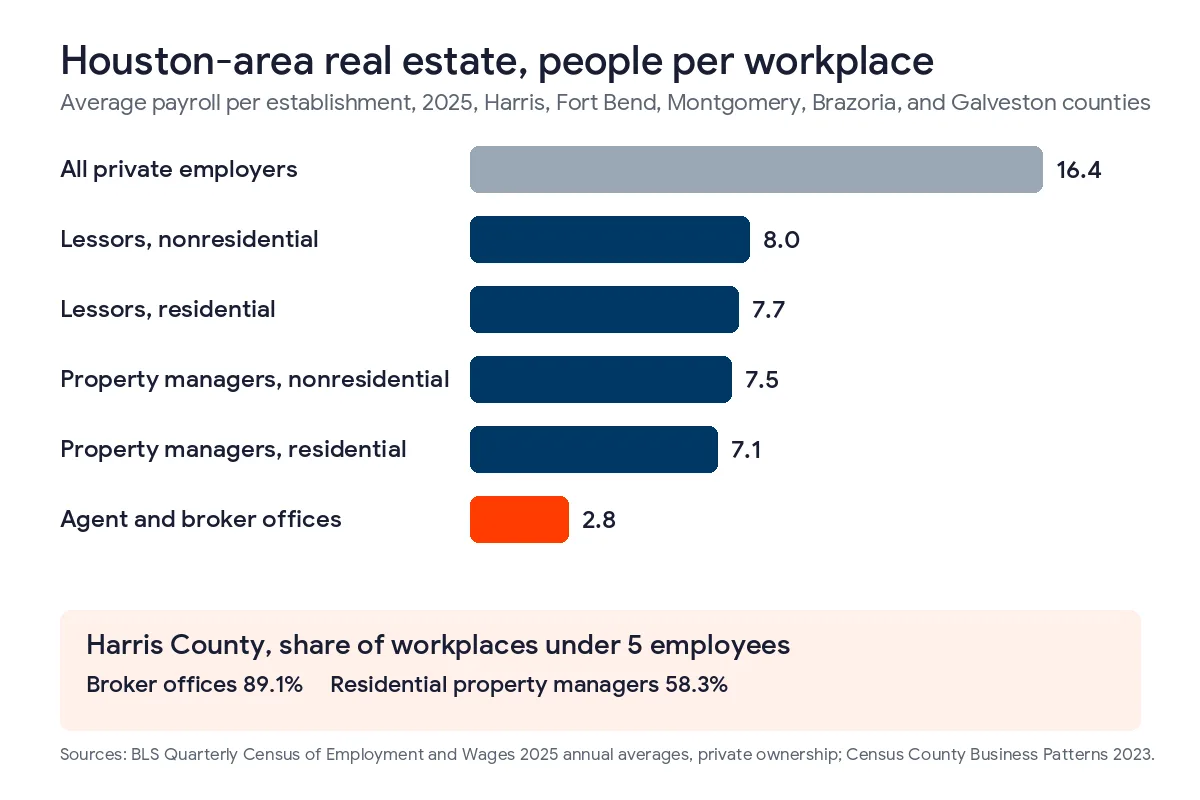
Private employers across Harris, Fort Bend, Montgomery, Brazoria, and Galveston counties averaged 16.4 people per workplace in 2025. Real estate ran far smaller. And the type of firm decided how small, according to the BLS Quarterly Census of Employment and Wages. I added the last column myself, pricing each average workplace at $160 per payroll seat, which is our $138 Fully Managed rate plus a $22 Business Premium license. Treat it as a sketch.
| Type of firm, 5 Houston-area counties | Workplaces, 2025 | People on payroll | Payroll per workplace | Monthly bill at $160 per payroll seat |
|---|---|---|---|---|
| Offices of real estate agents and brokers | 2,460 | 6,798 | 2.8 | about $442 |
| Residential property managers | 1,398 | 9,968 | 7.1 | about $1,141 |
| Nonresidential property managers | 485 | 3,652 | 7.5 | about $1,205 |
| Lessors of residential buildings | 1,517 | 11,634 | 7.7 | about $1,227 |
| Lessors of nonresidential buildings | 770 | 6,142 | 8.0 | about $1,276 |
| All private employers | 169,504 | 2,780,859 | 16.4 | not applicable |
No firm is average. Still, the pattern holds when you look at size bands. The Census Bureau’s County Business Patterns 2023 file shows 89.1% of Harris County broker offices with fewer than 5 employees. For residential property managers in the same county, it’s 58.3%, and at least 30 of their workplaces carry 50 or more people.
Brokerage payrolls are tiny. A property manager’s payroll is spread out across sites. And a commercial owner’s network carries devices that never log in at all. Those are 3 separate pricing problems wearing the same per-user rate.
Brokerages Pay for the Roster, Not the Payroll
The Texas Real Estate Commission’s license holder file listed 40,082 active sales agents whose license record names one of those 5 counties. Brokerage payrolls there held 6,798 people in 2025. That works out to about 6 licensed agents for every brokerage paycheck in the Houston area. 6 to 1. Sponsored agents are mostly independent contractors. Payroll never sees them.
The agents aren’t spread evenly. Far from it. The same file shows 4,050 sponsoring brokers with at least one active agent in those counties, and the median sponsor has just 2 agents, which is a very small firm by any measure. Only 55 sponsors have 100 or more, yet those 55 hold 51.5% of all the active agents in the 5 counties. And 13,036 agents, 32.5% of the total, started with their current sponsor within the last 12 months. Some are newly licensed. Many changed brokerages, and every change means an account to open at one firm and close at another. That churn costs money.
Per-user pricing, ours included, is written around employees. At a brokerage the people who need a company mailbox, a login to the deal software, and access to the listing files aren’t the people on payroll. Ask every provider one thing first. Are agents in this number? Make each quote say.
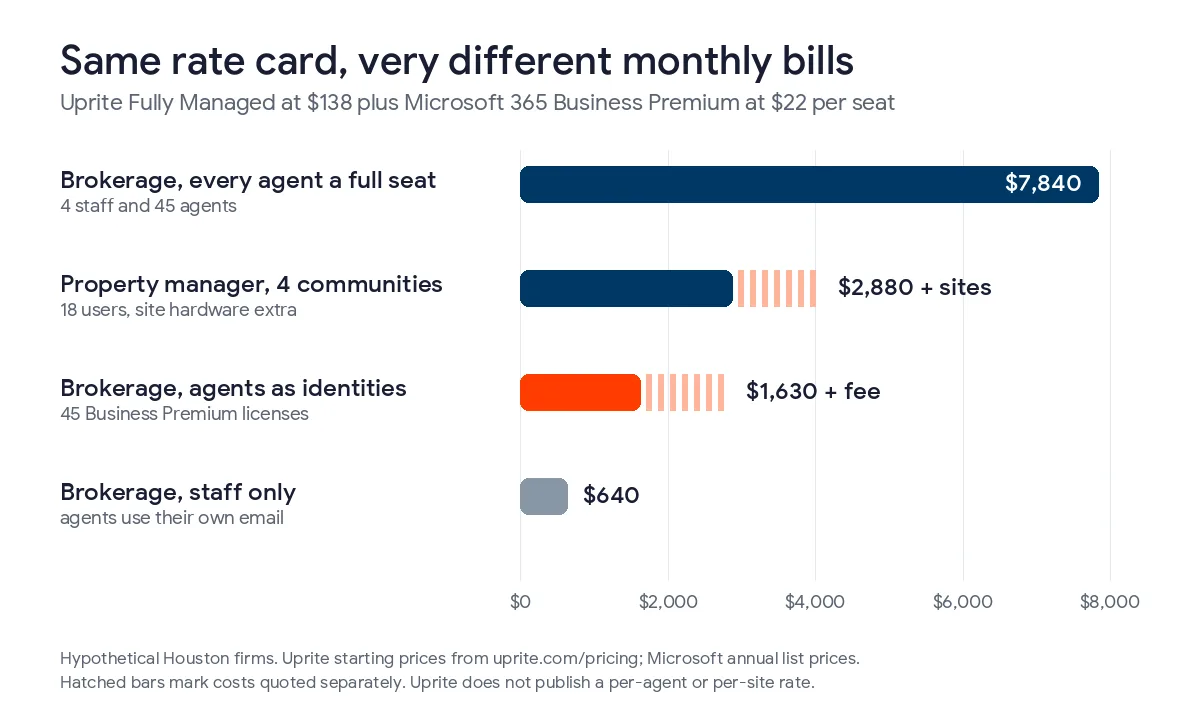
Here’s the spread for a made-up Katy brokerage with 4 staff and 45 sponsored agents, using only published prices.
| How agents are counted | Staff, 4 people | Agents, 45 people | Monthly total |
|---|---|---|---|
| Agents use their own email and devices | $640 | $0 | $640 |
| Agents get a Business Basic brokerage mailbox | $640 | $315, plus a management fee | $955 plus fee |
| Agents get a Business Premium identity with device controls | $640 | $990, plus a management fee | $1,630 plus fee |
| Every agent on a full Fully Managed seat | $640 | $7,200 | $7,840 |
There’s no dollar figure for the management fee in those rows. We quote it, but we don’t publish it, and I won’t guess another provider’s. If the 4 staff don’t need onsite work, our remote IT Essentials plan covers teams under 12, which brings the staff-only row to about $452 with Business Premium. That’s the floor. The gap between the first and last rows is $7,200 a month. Same office, same agents.
In Dallas, a brokerage can ask about putting agents on our remote IT Pro plan, which lands somewhere in the middle. Our breakdown of what real estate IT costs in Dallas walks through that option. That plan isn’t sold in Houston, so the jump from a licensed identity to a full seat is steeper here. In practice, I rarely recommend full seats for every agent. Few agents need one. Team leads, transaction coordinators, and anyone who sends or confirms wire instructions get one. Everyone else gets a managed identity inside the brokerage’s Microsoft 365 tenant.
That tenant matters. It matters twice. The first reason is records. TREC Rule 535.2(h) makes the broker keep transaction records for at least 4 years from closing or termination, and that’s hard to do when the deal lives in a personal inbox. The other reason is fraud. The FBI’s Internet Crime Complaint Center counted 12,368 real estate fraud victims and more than $275 million in losses in 2025, as NAR reported. Our post on real estate wire fraud and IT security in Houston covers the controls. This page only prices them.
Property Managers Pay for the Sites
Every leasing office is a small branch. It has an internet circuit, a firewall, Wi-Fi for staff and sometimes residents, a printer that stores scanned IDs, and often a camera recorder sitting on the same network. Multiply that by every community you manage. It adds up fast.
Our Fully Managed rate covers the people and the onsite visits. When a technician drives to a leasing office in Pearland to replace a dead access point, that trip is inside the $138. The access point isn’t. Hardware and the internet circuit at each site are quoted per site, and we don’t publish a per-site price, because a 40-unit property in Galveston and a 400-unit one in the Energy Corridor don’t need the same gear.
Take a made-up firm running 4 communities, with 6 people at the central office and 3 at each leasing office. That’s 18 users. At $160 each, the monthly bill is $2,880 before any site hardware. Each site adds its own gear.
The cost that doesn’t show up on any invoice is the community manager’s time. Houston’s property, real estate, and community association managers averaged $85,410 in the BLS May 2025 wage survey. Load that with the 1.43 benefits factor from the BLS Employer Costs for Employee Compensation release, and every hour a manager spends rebooting the leasing office router costs the firm about $59. Nobody tracks those hours, so nobody budgets for them.
Hiring your own IT person is the other path. A Houston computer user support specialist averaged $62,700 in the same BLS survey, which comes to about $89,600 a year once benefits are loaded. That equals 54 users on our $138 plan, the same break-even our breakdown of how much managed IT costs in Houston works through. And that buys one person. That person can’t be at 4 leasing offices at once, or cover their own vacation.
Commercial Owners Pay for the Building Systems
Commercial landlords and nonresidential property managers in the 5 counties averaged 7.5 to 8 people per workplace, so the user math looks a lot like a property manager’s, at roughly $1,200 to $1,300 a month for an average workplace at $160 a seat. The difference is what else is on the network. Badge readers, cameras, elevator phones, and building automation controllers don’t have users. They don’t appear in a per-user quote at all. Count them yourself.
Ask whether they’re covered. If the answer is vague, they aren’t. Ask for the device list. And a building system nobody patches is the kind of device that can end up bridging the tenant Wi-Fi and the property office.
The Gulf Coast Line on Every Houston Quote
Hurricane Beryl came ashore on July 8, 2024, and cut power to 2.7 million customers, 2.2 million of them on CenterPoint’s system, according to the Public Utility Commission of Texas investigation report in Project 56822. The same report says telecom disruptions in the Greater Houston area lasted from July 8 through July 16 for most providers, and AT&T didn’t fully restore wireline service until July 18. 10 days.

A leasing office whose files sat on a server in a closet could be shut for most of that stretch, with move-ins waiting on a working connection. An office whose files lived in Microsoft 365 could keep working from any phone or laptop with a charge and a signal. That’s why I care about one line on a Houston pricing page that most buyers skip. Our Fully Managed plan includes quarterly backup testing, meaning we restore real files on a schedule. IT Essentials tests annually. In a hurricane market, I’d pay for the quarterly test. Untested backups fail quietly.
Servers are also the most expensive way to own that risk. And they age. One Texas real estate firm we worked with had 14 or more virtual machines and was on the verge of spending $120,000 or more on new server hardware. We cut the environment to 3 virtual machines for about $20,000, which is the story behind how a Texas real estate firm cut IT costs. For scale, $120,000 would pay the 18-user property manager bill above for almost 42 months.
What a Houston Real Estate IT Quote Should Show
2 quotes with the same headline rate can describe very different services. Before you compare totals, make sure each quote spells out these lines.
- The per-user rate, and which plan it belongs to
- Who counts as a user, with staff, sponsored agents, and leasing staff priced on separate lines
- Microsoft licensing on its own line, so you can see the $7 or $22 per person
- Hardware and internet at each site
- Whether cameras, access control, and building systems are in scope
- How often backups are actually test-restored
- Onboarding fees, and what the rate does after year 1
Line those up side by side and the cheap quote often stops looking cheap. Read scope before price. It’s the same checklist we use when we rank the best IT providers for Houston real estate firms. For what it’s worth, we lock our rate for the first year and back it with a 120-day satisfaction promise.
When a Houston Real Estate Firm Doesn’t Need a Managed Provider
Some firms honestly don’t. A 2-person brokerage with a handful of agents, no office server, and no leasing sites can do well with Microsoft 365 Business Premium at $22 a person, multifactor sign-in for everyone, and a written callback rule for wire instructions. If that’s you, I’d spend the money on that callback rule before I’d spend it on us. Small is fine.
Growth changes the math. The picture flips once you have staff who can’t work when the network is down, more than one site, or agents moving in and out every month. That’s when a fixed monthly rate costs less than the hours you’re already losing. Firms with an in-house IT person usually fit co-managed support, which runs $60 to $130 per user in Houston, because the provider adds after-hours coverage, security tooling, and planning while your own person keeps handling the day-to-day requests.
Send us your staff count, agent roster, and number of sites through our contact page, or use the button below.
Tell us how many staff, agents, and sites you have. We’ll price each group on its own line, show Microsoft licensing separately, and tell you which people we think need a full seat and which don’t.
Price My Houston FirmHouston Real Estate IT Pricing Questions
How much does IT support cost a Houston real estate firm?
Between $125 and $175 per user per month for fully managed IT in 2026, plus $7 to $22 per user for Microsoft 365. Uprite Fully Managed IT starts at $138 per user. Firms that already employ an IT person can use co-managed support at roughly $60 to $130 per user.
Do sponsored agents count as users?
Only if the brokerage puts them on a plan. Across the 5 Houston-area counties there are about 6 licensed agents for every brokerage payroll job, so counting agents can multiply the user number several times over. In our Katy example, it moves the bill from $640 to $7,840 a month.
Is the $110 IT Pro plan available to Houston brokerages?
No. Uprite sells its remote IT Pro plan to teams outside the Houston and San Antonio areas. A Houston firm with 12 or more users gets Fully Managed IT at $138, or Co-Managed IT at $100 if it already employs an IT person, often with agents handled as licensed identities.
How are property management companies priced?
Per user, with each leasing office adding hardware and an internet circuit quoted per site. A firm with 6 people at its central office and 3 at each of 4 leasing offices has 18 users, or about $2,880 a month at $138 plus a $22 Business Premium license.
Should hurricane season change what a Houston firm pays for?
It should change what you insist on. After Hurricane Beryl, telecom service across Greater Houston was disrupted from July 8 to July 16, 2024, for most providers. Files kept in Microsoft 365 and backups test-restored every quarter keep closings and leasing offices working. Ask about restore tests.
Is hiring an IT person cheaper than managed IT?
Below about 54 users, usually not. A Houston computer user support specialist averaged $62,700 in May 2025 BLS data, or about $89,600 a year with benefits, which equals 54 users on the $138 plan. Above that, co-managed support plus one hire often fits better, since 1 person cannot cover nights or vacations.
What belongs on a real estate IT quote besides the per-user rate?
Licensing, site hardware, and anything without a user. Ask for Microsoft licensing on its own line, per-site hardware and circuits, building systems in or out of scope, backup test frequency, onboarding fees, and the rate after year 1. Uprite locks the first-year rate.