
Here is the short math. An EMR outage costs a Texas medical group about $488 per hour, per physician. That is the small half. The billing cleanup runs for weeks, charge capture leaks, and denials arrive 40 days later. Four hours of downtime routinely turns into three weeks of revenue cycle work.
A Texas medical practice loses about $488 per hour per physician when the EMR goes down, and the billing cleanup keeps costing money for weeks after the system comes back. That figure comes from a Stratus Technologies study of physician practices, and it counts lost productivity only. The rest of the bill shows up later.
This post sits under our overview of managed IT for Texas healthcare practices and narrows it to one number. What does an EMR outage actually cost. Not what a hospital loses. Not the enterprise per-minute figure that gets pasted into every vendor deck. What a 6-provider group in Sugar Land or a 14-provider multi-site in Bexar County writes off when Athena, Epic, or the network in the closet stops answering.
I have watched a lot of practices try to reconstruct this number after the fact. It never works. By the time anyone asks, the superbills are scanned, the schedule has been rebuilt twice, and nobody can say which claims went out late. So the outage gets logged as a bad Tuesday and the real cost disappears into the month.

What Does EMR Downtime Actually Cost a Texas Medical Practice?
EMR downtime is any period where clinical and billing staff cannot use the electronic health record for its normal purpose, whether the cause is the vendor’s platform, the practice’s own network, or a security incident. The cost is measured in lost provider productivity, charges that never get captured, and the labor required to put the record back together afterward.
Best available benchmark for a practice your size is the $488 per hour, per physician median from Stratus. It’s old, it’s conservative, and it’s still the closest thing to an apples-to-apples benchmark for an ambulatory group. A 5-physician practice with 10 cumulative hours of unplanned downtime in a year is out about $24,400 in productivity alone. Quietly. Across 12 months.
You will also see $7,900 per minute quoted for healthcare downtime. Ignore it. That number describes large hospital systems with operating rooms, imaging suites, and inpatient census on the line. Applying it to a clinic in Katy overstates the loss by roughly two orders of magnitude, and it makes the whole conversation less credible with the people who sign the check. Our general downtime cost formula walks through why the enterprise per-minute numbers break down at small scale.
| Published figure | Source and year | Who it actually describes |
|---|---|---|
| $488 per hour, per physician | Stratus Technologies | Ambulatory physician practices |
| $7,900 per minute | Healthcare IT downtime reporting, 2024 | Hospitals and large health systems |
| $1.9M per day | Ransomware downtime research | Health systems under active ransomware |
| 96 hours total outage | Applied Clinical Informatics, 2019 | A 300-bed hospital hit by ransomware in 2016 |
That last row is worth pausing on. Researchers publishing in Applied Clinical Informatics tracked a total EHR shutdown at a mid-Atlantic hospital, 48 hours fully dark followed by 48 hours partial. Lab turnaround times went up an average of 20 minutes per test, a 62% increase, and 11 of the 15 test types they measured slowed down. Nobody bills for that. It still costs money, because a provider waiting on a CBC is a provider not seeing the next patient. Delay compounds.
The Four Bills You Get for One Outage
Practices tend to think of downtime as a single event with a single cost. It isn’t. It arrives as four separate bills, spread across two months, and only the first one is visible while the outage is happening.
| The bill | When it lands | What it covers | Roughly what share |
|---|---|---|---|
| Hour One | During the outage | Lost visits, idle clinical and front desk staff, patients sent home | About 80% |
| The Backlog Tail | Days 1 to 21 | Paper re-entry, charge coding, eligibility rechecks, re-ordering labs and imaging | About 10% |
| The Denial Echo | Days 30 to 60 | Late filings, thin documentation, appeals and rework on claims that went out wrong | About 7% |
| The Trust Cost | Ongoing | Rescheduled patients who never rebook, referring offices that route elsewhere | About 3% |
Those shares are what we see across the healthcare clients we support, not a published dataset. Treat them as a shape, not a law. The shape is the useful part, because it tells you where the recoverable money is.
Hour One is mostly unrecoverable. The visit didn’t happen. But the Backlog Tail and the Denial Echo are both largely preventable, and together they run about 17% of the total on a clean outage. On a messy one, where nobody had a paper packet ready and the front desk improvised for four hours, that tail balloons. Every single time. We have seen a half-day outage generate three weeks of billing cleanup because the encounter forms didn’t capture enough to code from.
The 2024 Change Healthcare attack made this visible at national scale. In an AMA survey of physicians fielded from March 26 to April 3, 2024, 80% reported lost revenue from unpaid claims and 78% had lost revenue from claims they couldn’t submit at all. More than half used personal funds to cover practice expenses. 31% said they wouldn’t be able to make payroll. Most respondents were from practices with fewer than 10 physicians.
Read that last part again. Small practices. The exact profile of most Texas medical groups.
Your EMR Vendor’s Outage and Your Own Outage Are Not the Same Problem
These get lumped together constantly, and they shouldn’t be, because you buy completely different things to fix them.
A vendor outage is when Epic, athenahealth, eClinicalWorks, NextGen, Aprima, or Dentrix has a problem on their side. You can’t prevent it. You can’t escalate it faster than anyone else on the status page. What you can control is whether your practice keeps seeing patients while it’s happening, and whether the paper you generate is good enough to code from once the system is back.
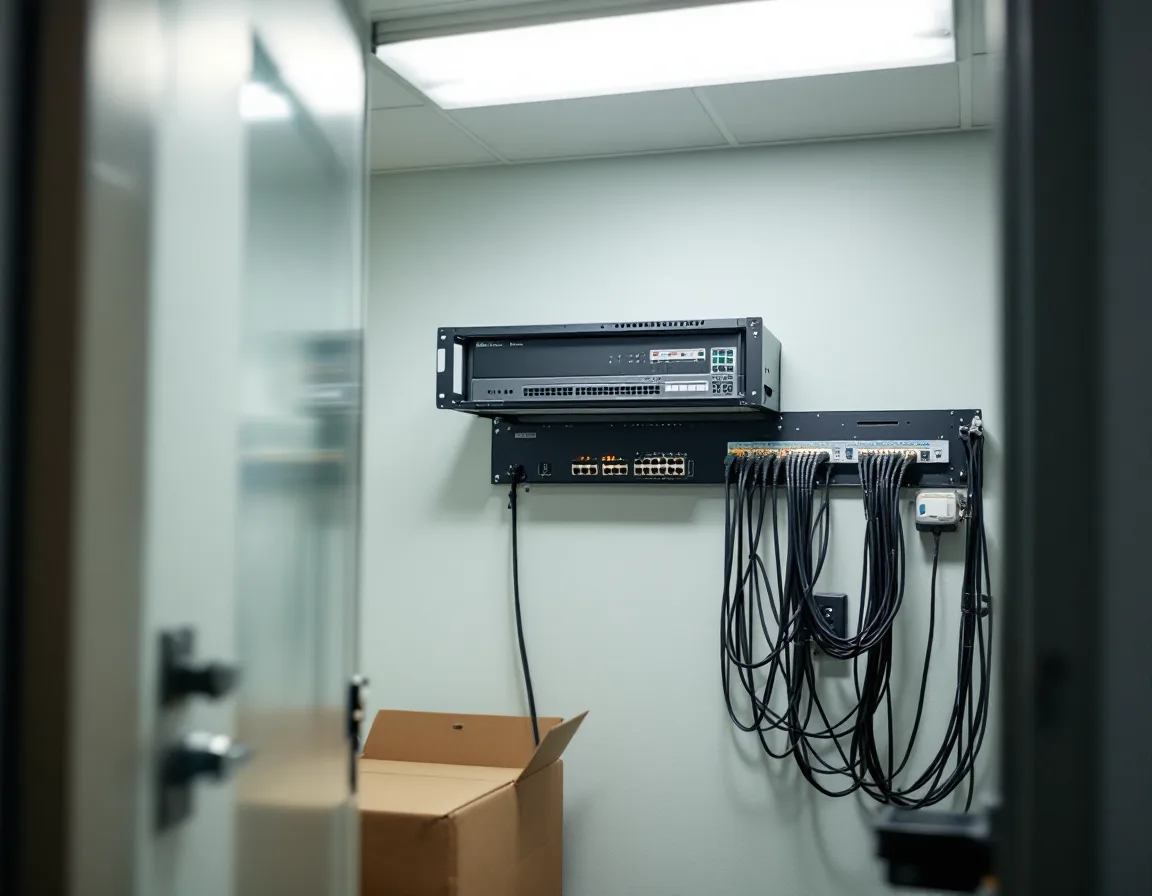
A local outage is everything on your side of the demarc. The circuit. The firewall. The switch in the closet that runs hot every August. DNS. The workstation images. Microsoft 365 authentication. Your VPN. Your practice being unable to reach a perfectly healthy cloud EMR is the most common outage we get called for, and it’s entirely preventable. All of it.
The trap is that both feel identical to the person at the front desk. The chart won’t load. That’s all they know. So practices buy the wrong fix, usually a bigger EMR support contract, when the actual failure was a single ISP with no failover and a router nobody had patched since 2023.
Here is the honest version of the split.
- Vendor-side outage. You prepare, you don’t prevent. Downtime packet, read-only chart copy, and a documented order of operations for the first 15 minutes.
- Your side. Redundant internet, tested failover, monitored network gear, patched endpoints, and a support model with a response clock you can actually enforce.
- Security incident. Different animal entirely. Comparitech counted 410 healthcare ransomware attacks in the first half of 2026, 2.3 per day, with 247 hitting direct care providers and a median ransom demand of $310,000.
Most practices are decently covered on the first, badly exposed on the second, and hoping about the third.
What a Four Hour Outage Costs a Six Provider Clinic
Numbers beat theory. Here is the arithmetic for a 6-provider primary care group, four hours down on a normal Wednesday, using the Stratus benchmark and conservative assumptions for everything else.

| Line item | The math | Cost |
|---|---|---|
| Lost provider productivity | 6 providers x 4 hours x $488 | $11,712 |
| Charge capture never recovered | 72 encounters x $130 net x 10% leakage | $936 |
| Re-entry and reconciliation labor | 22 staff hours x $32 fully loaded | $704 |
| Denial echo on late or thin claims | 4 extra denials, rework plus partial write-off | $430 |
| Total for one morning | $13,782 |
About $14,000. Roughly $3,450 an hour for a practice that probably budgets $4,000 to $6,000 a month for all of IT. Two outages like that in a year and the technology contract has paid for itself twice, which is a much more useful frame than any per-minute statistic. Use your own numbers.
Now change one variable. Make it a ransomware event instead of a circuit failure, and the four hours becomes days. The productivity line multiplies. The backlog tail stops being three weeks of tidy-up and becomes a full reconstruction of every encounter, every order, and every claim in the window, while the practice is also managing breach notification obligations. Different order of magnitude.
I am understating the reschedule cost in that table, by the way. Some of those patients don’t come back, and a specialty practice that fills its schedule six weeks out can’t simply absorb 72 displaced appointments into next Tuesday. For a dermatology or orthopedics group the trust line runs well above 3%.
The Texas Rules That Keep Running While Your EMR Is Down
Compliance doesn’t pause for an outage. This is the part that surprises practice managers, and it’s the reason downtime is a legal exposure in Texas and not just an operational one.
Start with the federal requirement. 45 CFR 164.308(a)(7) requires a contingency plan, and three of its five implementation specifications are marked Required rather than addressable. A data backup plan. A disaster recovery plan. An emergency mode operation plan, meaning documented procedures that let you keep critical business processes running while protecting ePHI during the outage itself. Testing and revision is addressable, which is precisely why almost nobody does it.
Then Texas adds its own clock. Under HB 300, the Texas Medical Records Privacy Act, a covered entity has 15 business days to fulfill a patient’s request for their electronic health record, in electronic form unless the patient agrees otherwise. HIPAA gives you 30 days. Texas cuts it in half.
A four-day EMR outage doesn’t stop that clock. Requests keep arriving through the portal, by fax, and from attorneys. If your record system is down for four days and the cleanup takes another two weeks, a request that landed the morning of the outage is now uncomfortably close to a deadline you can’t extend by pointing at your vendor.
Very few practices have ever mapped that. It is worth an hour with your compliance lead and our HIPAA IT compliance checklist to see where an extended outage would put you in breach of a Texas timeline rather than a federal one.
One more thing that gets missed. Emergency mode operation isn’t the same as having backups. Backups answer the question of whether you can restore. Emergency mode answers the question of how you deliver care and protect ePHI during the hours before you restore. Auditors ask about the second one and practices almost always answer with the first. Wrong answer.
What Actually Shortens the Outage
Five levers do most of the work. None of them are exotic and none of them require replacing the EMR.

| Lever | What it changes | Effect on the bill |
|---|---|---|
| Second circuit with automatic LTE or fiber failover | Cloud EMR stays reachable when one carrier drops | Removes the most common cause of local outage entirely |
| Read-only downtime copy of the chart | Providers can see meds, allergies, and last visit while the live system is out | Cuts clinical risk and keeps throughput near normal |
| Printed downtime packet, refreshed quarterly | Encounter forms that capture enough to code from | Shrinks the backlog tail and the denial echo |
| Tested restore, not just backup | Proves recovery time instead of assuming it | Turns an unknown recovery window into a number |
| Monitoring with an enforceable response clock | Someone is working the problem before the first patient arrives | Directly multiplies against every hour in the calculation |
The last one moves the most money and gets the least attention. Duration is the multiplier. Cutting a 5-hour recovery to 50 minutes saves more than any amount of arguing about your average revenue per visit. Uprite’s average response time across all clients is just over 5 minutes, and our team monitors client environments around the clock from Houston and San Antonio.
Honest caveat, and we lose deals over this one. If your practice runs a fully cloud EMR, has two carriers already, tests restores, and has a downtime packet that your MAs actually know how to use, you probably don’t need to change providers. You need to run one tabletop exercise a year and go back to seeing patients. Buying more IT won’t improve a number that’s already good. We would rather say so.
Where it does pay is the practice that has never measured any of this. An MGMA Stat poll of 326 medical group leaders on April 22, 2024 found that only 29% had updated their EHR or revenue cycle downtime protocols in the previous year. 61% hadn’t. 9% didn’t know. That’s the gap. That was two months after Change Healthcare, when the topic was as hot as it has ever been.
Where Texas Practices Get Caught
Five patterns come up over and over in this state specifically.
- Single carrier, no failover. The most expensive $200 a month a practice never spends. One fiber cut in a Houston construction zone and a 12-provider clinic charts on paper all afternoon.
- Weather that isn’t a hurricane. Coastal practices plan for named storms. The outages that actually hit are DFW hail knocking out a pole, a Central Texas ice event, or a transformer failure in the strip center. ERCOT held up through Winter Storm Fern in January 2026, but local distribution failures don’t care how the statewide grid is doing. We put a dollar figure on those statewide outages in the true cost of IT downtime for Texas businesses.
- Backups that have never been restored. Confidence isn’t the same as evidence. We have inherited environments where the backup job had been green for 14 months and the last successful restore test was never.
- Clearinghouse concentration. Change Healthcare taught everyone that a single billing dependency is a single point of failure. Most practices went back to one clearinghouse anyway.
- No named owner for the first 15 minutes. The outage starts and four people call four different vendors. Nobody logs a start time, which means nobody can calculate the cost afterward or file a business interruption claim.
That last one is quietly the worst. If you don’t know when the outage started and stopped, everything in this article is unusable to you, because every calculation depends on duration. No start time, no number.
Practices in the Houston metro can see how we handle this specific set of problems on our Houston healthcare IT page, and there’s a parallel one for San Antonio medical practices. To see how the wider Houston field compares, read our Houston healthcare IT provider comparison.
Put a Number on Your Own Outage
Three things are worth doing this month. Pull your last two outages and write down the start and stop times, even if you have to estimate. Run the four-line calculation above with your own provider count and your own net revenue per encounter. Then ask whoever supports your network to show you a restore test, not a backup report.
Uprite Services is a Texas managed IT and cybersecurity provider that has supported businesses across Texas since 1999, with a 42-person team and a healthcare practice built around HIPAA and Texas Medical Records Privacy Act obligations. We support 10 to 250 user environments running Epic, athenahealth, eClinicalWorks, Aprima, and Dentrix, and we’re a seven-time Channel Futures MSP 501 honoree. What makes the healthcare work different from our general managed IT is the compliance evidence file that comes with it.
If you want the number for your own practice, ask us for a healthcare IT assessment. We will run the calculation against your last three outages, review your contingency plan against 164.308(a)(7), and show you which of the five levers would have shortened them. You keep the worksheet either way. If disaster recovery is the piece you already know is thin, start with our disaster recovery planning for Texas businesses instead.
What Texas Practice Managers Ask About EMR Downtime
How much does one hour of EMR downtime cost a medical practice?
About $488 per physician, per hour, in lost productivity, based on the Stratus Technologies benchmark for ambulatory practices. A 6-provider group is therefore losing roughly $2,900 an hour before you count billing cleanup. Add the backlog tail and the denial echo and the working figure lands closer to $3,400 an hour. Use your own encounter volume and net revenue per visit if you have them, because specialty practices with high per-visit revenue can run double that. A procedure-based specialty carrying facility and anesthesia charges on the same encounter runs several times the primary care figure, which is why the benchmark is a starting point and not an answer.
Does our EMR vendor owe us anything when their platform goes down?
Read your service agreement before you assume so. Most ambulatory EMR contracts cap the remedy at a service credit worth a small slice of a single monthly subscription fee, which won’t cover a morning of lost visits.
Is a cloud-hosted EMR safer from downtime than a server in our office?
Safer from hardware failure. Not safer from your own network. Moving to a cloud EMR shifts the risk from a server in the closet to the path between your workstations and that platform, which means your internet circuit, your firewall, your DNS, and your identity provider all become single points of failure. Practices that migrate to the cloud and keep one carrier have traded a known risk for a less visible one.
What is an emergency mode operation plan, in practical terms?
It is the documented set of procedures that lets your practice keep delivering care and keep protecting patient data while the EMR is unavailable, and it has to exist on paper before the outage rather than get invented halfway through one. HIPAA requires it at 45 CFR 164.308(a)(7)(ii)(C) as a Required specification, not an addressable one. In practice it means downtime encounter forms, a read-only chart source, a defined escalation path, and rules for where paper lives and how it gets secured and reconciled afterward.
How long should we expect a ransomware outage to last?
Longer than a circuit failure, by a lot. Plan for days. Published healthcare ransomware research puts average downtime in the range of 17 to 24 days for organizations that are hit, and Comparitech counted 410 healthcare ransomware attacks in the first half of 2026 alone, 2.3 a day. Recovery has been improving. It is still a fundamentally different planning horizon than a circuit failure, and the practices that come through it well are the ones that tested a restore before they needed it.
Do we still have to meet the 15 business day record request deadline during an outage?
Nothing pauses it. Texas HB 300 sets 15 business days for electronic health record requests and doesn’t carve out an exception for system unavailability. That is half the federal HIPAA window. A multi-day outage plus a two-week billing and records cleanup can put a request that arrived on day one right at the edge, so track open requests separately during any extended downtime rather than assuming the queue will sort itself out.
Will managed IT actually reduce what downtime costs us?
It reduces duration and frequency, which is where the money is. No provider eliminates outages. Carriers drop circuits, vendors have bad days, and hardware dies on its own schedule. What changes is whether you learn about it from an alert at 3 a.m. or from a front desk supervisor at 8 a.m., and whether recovery takes 45 minutes or two days. Ask any provider you’re evaluating for their average response time and their last restore test date.