Managed IT services give growing businesses lower and predictable IT costs, stronger data protection, faster support response, less downtime, and built-in compliance and digital transformation support, all delivered by an outside team of experts for a flat monthly fee.
Managed IT services hand your day-to-day technology to an outside team for a flat monthly fee. You get 24/7 monitoring, stronger security, faster support, less downtime, and help with compliance and digital transformation. For most small and mid-sized businesses that costs less than one in-house hire, and it turns unpredictable IT bills into a planned, scalable expense that supports growth.
Most companies find managed IT services helpful for streamlining operations, improving security, and increasing productivity. By partnering with an MSP, you can focus on core business goals, stay ahead with modern systems, and keep your IT running efficiently. Managed IT services hand the time-consuming work to people who do it every day. Here we walk through the main benefits of managed IT services and explain why the right managed services provider can be a real turning point for your business.
What are Managed IT Services?
Managed IT services have become the backbone of how modern businesses run. The benefits of managed IT services include reduced cost, higher productivity, and easier adoption of modern technology. Maintaining an in-house IT team has become expensive, and many small businesses end up cutting corners on network maintenance because of it. For larger companies that already have internal IT, an MSP can step in with co-managed IT services, freeing your team to focus on strategic work. Either way, you improve your infrastructure, reduce risk, and keep your attention on business goals.
| Factor | In-House IT | Managed IT Services |
|---|---|---|
| Cost model | Salaries, benefits, and surprise repair bills | Flat, predictable monthly fee |
| Coverage | Business hours, limited by staff size | 24/7 monitoring and support |
| Expertise | One or two generalists | A full team across security, cloud, and compliance |
| Scalability | Hire and train to grow | Scales up or down with your needs |
| Security | Often reactive and under-resourced | Proactive monitoring and current tooling |
Managed IT is not the right fit for everyone. If you already run a mature internal IT team with full 24/7 coverage, a co-managed model usually makes more sense than handing everything over. For most growing companies without that depth, though, outsourcing closes a real gap.
The Top 9 Managed IT Services Benefits
The benefits of managed services let businesses keep daily operations running while meeting both short-term and long-term needs. From centralizing vendor management to simplifying costs and running 24/7 remote monitoring, there is a lot to gain from working with an MSP.
The top 9 benefits of managed IT include:
1. Improved IT Budgeting
In business, IT costs swell quickly. Managing an evolving organization’s infrastructure, from maintaining existing systems to upgrading hardware, can lead to significant added costs. Managed services reduce those sudden cost shocks by:
- Continuously maintaining systems so your IT infrastructure runs smoothly for longer.
- Forecasting future IT spending based on current and future growth plans.
There is often a hidden cost in the form of technical debt, the expense of running a business on outdated technology. It adds time to processes that other companies finish faster, and it quietly eats into your margins.
2. Access to a Team of Experts
Your business isn’t an IT company. It specializes in selling and delivering products or services, yet IT is essential to all of it. Many companies rely on managed IT because securing top talent is hard. With on-call expertise, you reach a dedicated specialist in minutes without making a full-time hire. Having skilled professionals handle IT issues keeps operations smooth and adds a layer of security for the whole business.
3. Strengthen Data Protection
To stay competitive, many managed service providers invest heavily in technology. When you partner with one, you usually benefit from that advanced tooling. The stakes are high here. According to IBM’s Cost of a Data Breach report, the global average breach now runs into the millions, which is exactly the kind of risk strong protection is meant to prevent. That partnership typically delivers:
- Less downtime through proactive business continuity and disaster recovery services.
- 24/7 monitoring and cybersecurity solutions that reduce vulnerabilities.
- Enterprise-grade tools that strengthen data protection across the whole organization.
4. Reduce response time
MSPs back their work with Service Level Agreements and Service Level Goals that set clear response times for specific IT events. To stay accountable, they often run quarterly performance and satisfaction reviews, so every part of the agreement is being met and the goals are on track.
5. Minimize network downtime
Downtime is one of the most expensive problems a business can face, and it rarely strikes at a convenient time. Managed service providers work to minimize it through:
- Network monitoring and management
- Comprehensive business continuity planning
- Offsite and onsite data backup and disaster recovery services
6. Lower and Predictable Operational Costs
Today companies are looking for ways to cut operating costs and avoid surprise expenses that hurt cash flow. If cost reduction is one of your goals, managed IT services are the solution.
Trying to manage IT in-house can lead to budget overruns and hidden inefficiencies. From unplanned hardware failures to emergency repairs, many companies spend more on reactive fixes than on strategic improvements. Non-technical employees often get pulled into makeshift IT roles instead of doing their actual jobs, which costs the business more over time.
And when systems go down, the costs add up fast. According to Statista, enterprise server downtime can cost roughly $11,600 per minute. We have seen this play out firsthand. In one oil and gas IT case study, moving from reactive break-fix to proactive managed support cut downtime risk and strengthened cybersecurity.
Managed IT replaces that reactive chaos with a stable, proactive model. You get a full team of specialists at a predictable monthly rate, typically far less than the cost of a single in-house technician. This fixed-cost approach lets you:
- Eliminate overhead expenses that full-time hires require.
- Reduce downtime and emergency spending through proactive monitoring, issue prevention, and the right planning.
- Avoid opportunity costs caused by internal staff being pulled into technical issues.
- Plan budgets confidently with a clear monthly or annual technology spend.
Whether you’re a small business stretching every dollar or a mid-sized firm modernizing without breaking the bank, managed IT offers a cost-effective, scalable way to align your technology with your business goals.
7. Excellent Compliance Support
Because the IT industry is heavily regulated for data privacy, any company needs reliable compliance support when it outsources. In-house teams can feel overwhelmed by these rules, and even skilled staff may struggle to keep up with the latest standards and legal requirements. For regulated industries, that includes keeping pace with frameworks like HIPAA. A good MSP protects your business from penalties and reputation damage by making sure your IT systems consistently meet those standards.
8. Reliable System Performance
Reliable IT is critical to keeping a business running without interruption. With careful monitoring and regular maintenance, managed IT providers keep your systems operating at their best. That improves the user experience, raises productivity, and strengthens your competitive edge. It also surfaces and resolves potential problems early, so performance stays high.
9. Accelerating Digital Transformation and AI Readiness
Technology is moving fast, and companies that want to stay competitive can’t afford to fall behind. Whether it’s moving systems to the cloud, enabling hybrid work, or using AI tools to automate repetitive tasks, digital transformation has become a necessity.
Managed IT services help businesses keep up. Instead of figuring out new systems on your own, you get guidance from people who’ve done it before. MSPs make sure your infrastructure is modern, secure, and ready for whatever comes next, whether that’s rolling out a new platform, adopting AI-powered tools, or building systems that scale as you grow.
In short, your MSP becomes a strategic partner, not just for keeping the lights on, but for helping your business adapt, innovate, and thrive.
Why Choose Uprite Managed IT Services?
Uprite IT Services is a dependable managed IT provider built around security, efficiency, and scalability. We build customized strategies that line up with each client’s goals, and our team keeps operations smooth through proactive monitoring and modern technology. Partnering with us means a future-ready IT environment designed for growth. Our services include:
- AI-driven security that protects sensitive information around the clock.
- 24/7 IT support so technical problems get solved quickly, day or night.
- Scalable infrastructure that grows with your business.
- Proactive monitoring and maintenance that keeps systems performing and uptime high.
Common Questions About Managed IT Services
What do managed IT services actually include?
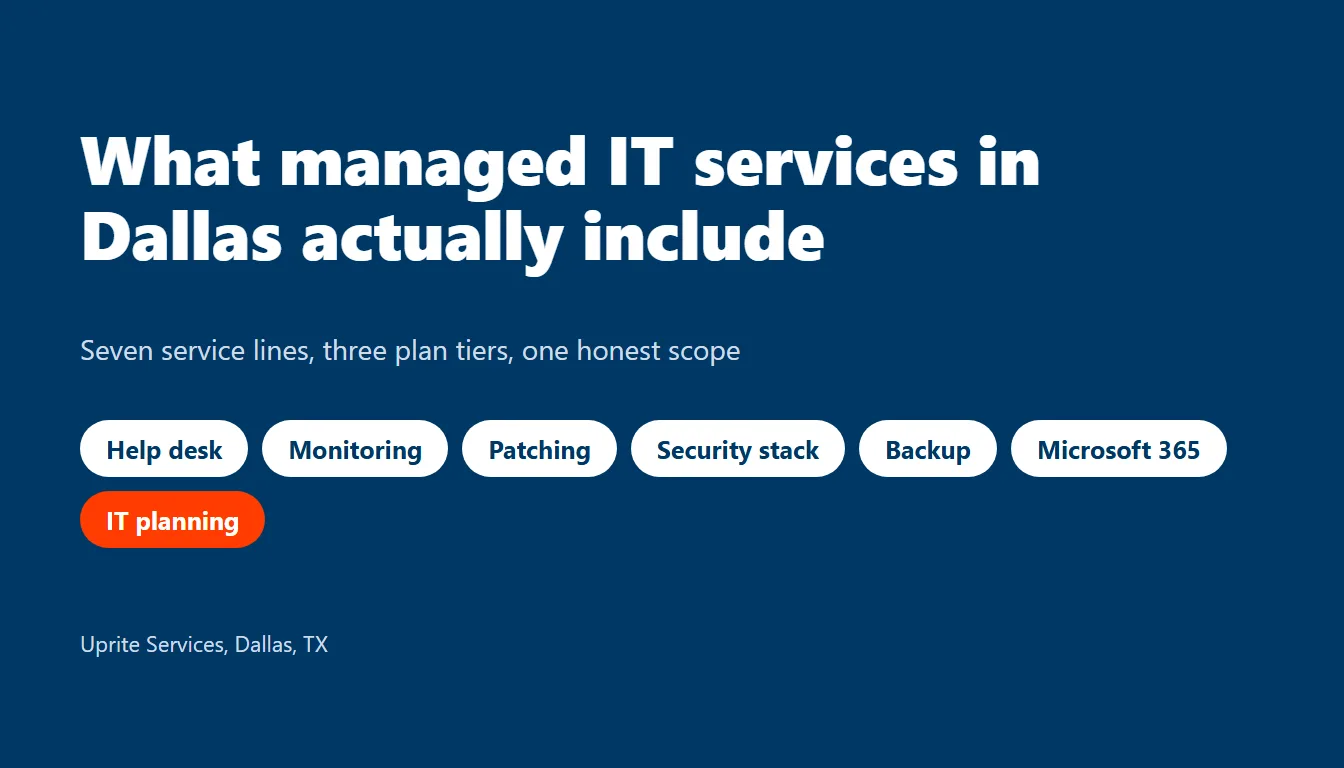
Most managed IT plans cover 24/7 monitoring, help desk support, cybersecurity, data backup and disaster recovery, patching, and strategic IT planning. The exact mix depends on your provider and your contract, but the goal is the same. Keep your systems running so your team can focus on the business.
How much do managed IT services cost?
Pricing is usually a flat monthly fee based on the number of users or devices you support. That predictable model is often less than the cost of one full-time in-house technician, and it replaces the surprise bills that come with reactive break-fix repairs.
Is managed IT only for large companies?
No. Small and mid-sized businesses often benefit the most, because they rarely have the budget for a full internal IT department. An MSP gives a 20-person company access to the same enterprise-grade tools and expertise a large enterprise uses.
What is the difference between managed IT and co-managed IT?
Managed IT means an outside provider runs your technology end to end. Co-managed IT means the provider works alongside your existing internal staff, taking on monitoring, security, or after-hours coverage so your team can focus on higher-value projects.
How do managed IT services improve security and compliance?
Providers run continuous monitoring, deploy current cybersecurity tools, and keep systems patched against new threats. They also track the standards your industry requires, such as HIPAA, so you avoid the fines and reputation damage that come with a failed audit or a breach.
How quickly can a managed IT provider respond to issues?
Response times are set in a Service Level Agreement, so you know the commitment in writing before anything breaks. Many MSPs also run quarterly performance reviews to confirm they are hitting those targets.
Conclusion
Managed IT services offer real advantages, from cost control and cybersecurity to better efficiency and disaster recovery, all of which feed business growth. With outsourced IT management, you tap into the best technology and the support of experts. Uprite IT Services is a fully integrated managed IT solutions provider that helps businesses turn technology into a competitive advantage.
Ready to turn IT into a growth engine? Uprite’s team handles security, support, and strategy so you can focus on running the business. Get a free quote or call us at (866) 570-3065.
If you are weighing these benefits against your current setup, see how our managed IT services in Texas bundle monitoring, security and support into one predictable monthly cost.