Fully managed 24/7 IT support for a Fort Worth plant starts at $138 per desk seat whether it runs 1, 2, or 3 shifts. Each added shift adds about $660 a month for a 40-person crew. The rate stays flat. The number of people who need an answer at 2 AM doesn’t.
Plant managers ask me what 24/7 costs. I get why. Every provider in Tarrant County says it, and almost none print a number, which leaves you comparing one promise against another with nothing to hold either of them to. Our 24/7 IT support in Fort Worth page explains how the night line works. This guide prices it. I built 3 plants on paper with the same office and the same 40-person crew on every shift, then added a shift each time. The line that moves isn’t the one you’d guess.
I started from federal wage data and our own published rates, then asked what each extra shift costs under 3 different ways of covering it, and 2 of the answers surprised me. A second shift is cheap on a managed plan. Staffing it yourself is brutal. That is the gap. It is wide.
A Fort Worth plant pays $138 per desk seat for 24/7 support at Uprite, and a second or third shift adds floor users at $110 each instead of raising that rate. In our 3-plant model, 1 shift costs $2,682 a month, 2 shifts cost $3,342, and 3 shifts cost $4,002. Hiring people to cover the same calendars runs $94,293 to $471,464 a year. Hourly after-hours billing beats a plan only when night calls stay under about 3 hours a month.
How much does 24/7 IT support cost a Fort Worth manufacturer in 2026?
24/7 IT support for a manufacturer means a named provider answers your help line, triages the problem, and starts fixing it at any hour, including nights, weekends, and holidays. In Fort Worth in 2026 that costs $110 to $138 per user per month at Uprite, with plant-floor OT and compliance scope priced as separate lines.
| Plan | Starts at, per user per month | Nights and weekends | Where it fits in a plant |
|---|---|---|---|
| Fully Managed IT | $138 | Yes, 24/7, with on-site infrastructure | Office, engineering, and anyone the plant can’t run without |
| IT Pro, remote only | $110 | Yes, 24/7, remote | Floor users on second and third shift who need help after the office closes |
| Co-Managed IT | $100 | Yes, coverage behind your own IT person | Plants with 1 IT hire who needs nights and vacation backfill |
| IT Essentials, remote only | $91 | No, business hours with 8 hours per user per month | Day-shift floor users who log in a few times a week |
| MSSP Security Focus | $40 | Security monitoring and SOC | A security layer over an in-house team |
Those are the rates on our pricing page, and the page says every plan except IT Essentials includes 24/7 support availability, which is the sentence most Fort Worth plant managers never find because it sits two screens below the plan cards. IT Pro is built for teams of 12 or more outside Houston and San Antonio. Fort Worth qualifies. Our Texas MSP Pricing Index puts the Dallas-Fort Worth market for fully managed IT at $135 to $200 per user, so $138 sits at the low end of that band.
Notice what’s missing. There’s no night surcharge and no per-shift multiplier anywhere on that page, which is the whole reason this question is worth a guide, because the answer isn’t sitting on a rate card.
Why does a second shift change the bill when the rate doesn’t?
Because the rate prices a person, and a shift adds people. That is the mechanism. Your office staff work days whether the plant runs 1 shift or 3. The crew doesn’t. Every shift brings a new set of leads, quality techs, and maintenance staff who sign into shared terminals, and each of them needs a login that works and somebody to call when the scanner stops talking to the ERP at 1 in the morning.
I sort plant staff into 3 groups when I scope a Fort Worth shop. Desk users stay at the managed rate. Operators who never touch a system don’t need a managed seat at all. The middle group is where shift count lives, meaning the leads and techs who log in a few times a shift and need their own identity, a patched terminal, and a person to call. How we support plants across the city is laid out on our manufacturing IT services in Fort Worth page.
Here’s a correction to my own work. In our manufacturing IT cost in Texas guide I priced those floor users at the $91 lighter tier and added a caution that it’s a business-hours plan. I should have gone further. On day shift, $91 works fine, but on second shift it buys you a help line that opened at 8 and closed at 5, while the person who needs it is clocking in at 3 PM. That’s no help.
What do 1, 2, and 3 shifts cost in a Fort Worth plant?
Here is the setup. Take a plant with 12 desk seats in the front office, all on day shift. Every shift has 40 floor workers, and 6 of them are leads, quality techs, or maintenance staff who log in. That makes the plant 52 people on 1 shift, 92 on 2, and 132 on 3. Simple enough. Desk seats are $138. Day-shift floor users are $91. Floor users on second and third shift sit at $110, the published IT Pro rate, because they need help after the office closes and the $91 plan won’t give it to them.

| Monthly line | 1 shift | 2 shifts | 3 shifts |
|---|---|---|---|
| Desk seats, fully managed (12 x $138) | $1,656 | $1,656 | $1,656 |
| Day-shift floor users (6 x $91) | $546 | $546 | $546 |
| Second-shift floor users (6 x $110) | $0 | $660 | $660 |
| Third-shift floor users (6 x $110) | $0 | $0 | $660 |
| OT boundary and machine PC monitoring (12 x $40) | $480 | $480 | $480 |
| Monthly provider fee | $2,682 | $3,342 | $4,002 |
| Provider fee per employee | $51.60 | $36.33 | $30.32 |
| Annual provider fee | $32,184 | $40,104 | $48,024 |
Each shift adds $660 a month, or $7,920 a year. That is about 25% on top of the 1-shift bill for a second shift. Small. Look at the per-employee row. The cost per head falls from $51.60 to $30.32 as the shifts stack up, because the office and the OT boundary are fixed costs that get spread across more people, and the only thing that grows is the crew who need a login after dark.
Two honest limits. The $110 is a stand-in. The real floor-user rate for a given plant gets quoted after we walk the floor. And the table shows the provider’s fee only. Microsoft licenses, your ERP, and any one-time segmentation project sit outside it, and our manufacturing cost guide prices those lines separately, while our managed IT cost in Fort Worth breakdown shows how a headcount turns into billable seats.
How does that compare with hiring people to cover the same hours?
It isn’t close. The gap grows with every shift. One full-time hire gives you about 1,840 real hours a year after paid time off, holidays, and training, and we walked through that math for metroplex plants in our guide on how DFW manufacturers choose between in-house IT and an MSP. Here I’ve priced it for the 3 plants.
One wrinkle on cost. That guide loads a user support salary at the private-industry rate of 1.43, which gives $90,133. Plants aren’t average. The latest BLS employer cost data shows manufacturers paying $48.62 in total compensation for every $32.50 in wages, a load of 1.496, and the BLS May 2025 wage estimates put a Dallas-Fort Worth user support specialist at $63,030. Multiply the two and one hire costs $94,293 a year.

| Plant schedule | Production hours a year | Hires to cover it | In-house cost, loaded | In-house cost per production hour | Uprite fee a year | Uprite fee per production hour |
|---|---|---|---|---|---|---|
| 1 shift, 5 days | 2,080 | 1 | $94,293 | $45.33 | $32,184 | $15.47 |
| 2 shifts, 5 days | 4,160 | 3 | $282,879 | $68.00 | $40,104 | $9.64 |
| 3 shifts, 6 days | 7,488 | 5 | $471,464 | $62.96 | $48,024 | $6.41 |
I round the hires up, since you can’t hire a third of a technician and a roster of exactly 4 breaks the first time somebody gets the flu. Two shifts need 2.3 people and 3 shifts need 4.1. Covering all 8,760 hours of the year takes 4.8, before anyone takes a vacation. Even at 1 shift the plan costs less than the hire. Not by a little. The table shows it.
These aren’t equal products, and I won’t pretend they are. A hire stands on your floor, knows which press needs a particular boot order, remembers which operator unplugs the wrong cable, and answers in person, which no phone line can match. We triage night calls inside 10 minutes, fix most things remotely before anyone drives, and send a technician from Dallas when the fault is physical. Not every plant needs us. If you run 1 shift with a hosted ERP and a sharp generalist, keep that person.
When does hourly after-hours billing beat a 24/7 plan?
The plan loses when your plant is quiet at night. Some providers sell a business-hours contract and meter everything else, and our guide to what an after-hours IT support SLA should say found Texas providers typically quoting 1.5x to 2x the standard rate after hours, with true emergency callouts landing between $250 and $500 an hour. Here’s how that meter compares with the plan.
| Shift added | Added monthly cost on a 24/7 plan | Break-even night hours a month at $250 | Break-even night hours a month at $500 |
|---|---|---|---|
| Second shift | $660 | 2.6 | 1.3 |
| Second and third shifts | $1,320 | 5.3 | 2.6 |

Say your second shift calls twice a month and each ticket takes 45 minutes. Metering costs $375 against $660 for the plan, so metering wins. At 5 calls a month you’ve crossed the line, and every call after that is money you could have kept. Count your own calls first.
Planned work changes the answer faster than emergencies do. Roughly half the night work we see in Fort Worth is scheduled, because firewall swaps, switch upgrades, and controller patches can only run while the line is down. A single 4-hour window a month at $250 an hour costs $1,000, which beats the whole second-shift premium before anything breaks. Ask any provider, us included, whether window work sits inside the fee or on a meter.
What else raises a plant’s night coverage price?
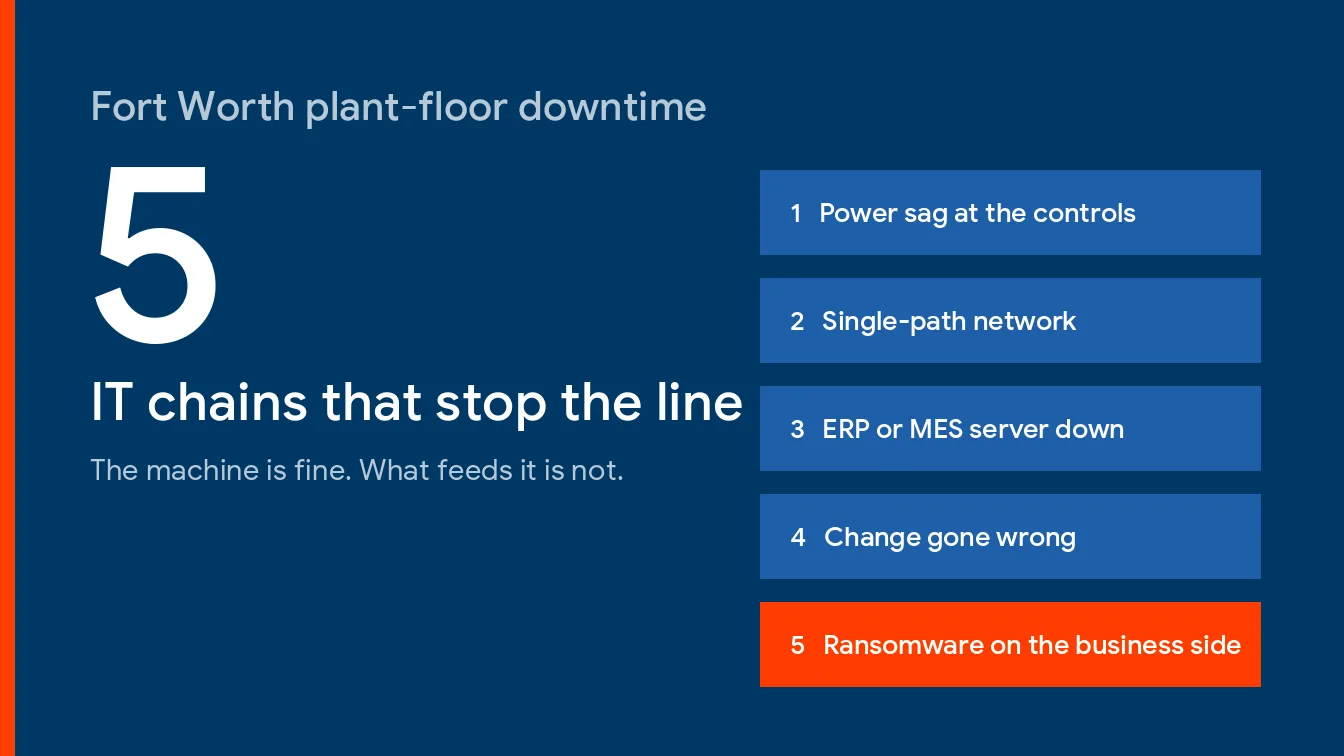
Shift count is the smallest of the drivers. Scope is the real lever. Scope moves the number far more, and scope lives in the same hours as your shifts. An OT network that runs all night needs watching all night. A compliance duty doesn’t pause at 5 PM either, so the same plant can look cheap or expensive depending on who its customers are. Customers set the price. What takes a line down at night before cost even enters the picture is in our guide to how IT failures stop a plant floor.
| Driver | 2026 band per desk seat | What it changes after hours |
|---|---|---|
| Plant-floor OT in scope | $200 to $300 | Machine PCs and the control network boundary get watched on every shift |
| CMMC Level 1 | $150 to $185 | Basic safeguards for federal contract information |
| CMMC Level 2 | $175 to $250 | Controlled unclassified information, logging, and incident response that can’t wait until morning |
| ITAR | $250 to $330 | US-person access limits and tighter remote access rules |
| Planned maintenance windows | Quoted from the plant’s calendar | Rollback plans and a hard restart time before the next shift |
If you sell to defense primes, start with our guide to IT compliance for DFW manufacturers. If your controllers sit on the same network as your email, read the OT cybersecurity audit guide first, because that finding changes the quote more than any shift count.
What does Fort Worth add to the math?
Size, mostly. The BLS Quarterly Census of Employment and Wages counted 1,951 private manufacturing establishments in Tarrant County in 2025, employing 93,180 people at an average of 47.8 per plant. Transportation equipment alone accounted for 33,665 jobs, about 255 per establishment. QCEW doesn’t report shift schedules, so I can’t tell you how many of those plants run nights, but a plant that size is the kind where a second shift is common.
Defense work adds a clock. A supplier holding covered defense information has to report a cyber incident through DIBNet within 72 hours of discovery under DFARS 252.204-7012. Discovery tends to happen at night, when nobody is reading the alert queue, and a voicemail box doesn’t start that clock, so a Monday callback has already spent 2 of the 3 days. The clock doesn’t wait.
The attackers know your schedule. A 2021 FBI and CISA advisory warned that ransomware attacks were increasing on holidays and weekends, when offices are closed, and told organizations to name IT security staff who can be reached during those periods. Third shift is the same exposure on a Tuesday. Plan for it.
One thing I’ll say plainly, since this is a pricing guide. Uprite has no Fort Worth office. We cover Tarrant and Parker counties from Dallas, so most night fixes happen remotely first, and a van comes when the fault is physical. Be wary of any provider that claims a Fort Worth garage full of night technicians. If your plant also flows down defense work, our guide to CMMC Level 2 for a 50-person Fort Worth shop covers the compliance side. Ask to see the roster. Names, not promises.
What should a night coverage quote say before you sign?
- Which plan each shift’s floor users sit on, with the rate beside each one.
- Whether $91 business-hours support covers anyone who works after 5 PM.
- Who answers at 2 AM, an engineer or an answering service.
- Whether planned maintenance windows sit inside the fee or on an hourly meter.
- The after-hours rate and the minimum increment for anything outside the plan.
- What the quote does to your price when you add a fourth line or a third shift.
That last one is the test. A provider that can’t tell you what a third shift costs hasn’t looked at your plant, and the quote it hands you will show that the first time you add a line or a crew. Our MSP SLA benchmarks show what response commitments look like when they’re actually written down. Ask for all 6.
Questions Fort Worth plant managers ask about night coverage pricing
How much does 24/7 IT support cost for a manufacturer in Fort Worth?
At Uprite, 24/7 IT support for a Fort Worth manufacturer starts at $138 per desk seat per month, with floor users on second and third shift from $110. In our 3-plant model, 1 shift costs $2,682 a month and 3 shifts cost $4,002.
Does a second shift double my IT support bill?
Only by about 25%. A second shift added $660 a month to a plant already paying $2,682, because only the floor users who need help at night get added. The office seats and the OT boundary don’t change.
Is 24/7 monitoring the same as 24/7 support?
Not quite. Monitoring files an alert for somebody to read later. Support means an engineer answers, works out what broke, and starts fixing it while you’re still on the phone.
How many IT staff would a 3-shift plant need in-house?
About 5. A plant running 3 shifts, 6 days has 7,488 production hours, and one hire covers about 1,840, so the math says 4.1, and you round up because 1 absence breaks a roster of 4 and nobody wants that call at 3 AM.
Does after-hours hourly billing ever cost less than a 24/7 plan?
Yes, for a quiet plant. At $250 an hour, a second shift breaks even at about 2.6 billable night hours a month, so 2 calls of 45 minutes cost $375 instead of $660.
What does emergency IT callout cost per hour in Texas?
Texas providers typically quote 1.5x to 2x their standard rate after hours, and true emergency callouts commonly land between $250 and $500 an hour. Ask for the rate and the minimum billing increment in writing.
Does Uprite have a Fort Worth office?
Uprite covers Fort Worth from its Dallas office, about 35 miles away. There is no Fort Worth office. Fixes start remotely, and on-site dispatch covers Tarrant and Parker counties when the fault is physical.
Send me your shift calendar, your desk and floor headcount, and the ERP you run. I’ll price each shift as its own line, so you can see which one moves the number and argue with it.
Get a Free Night Coverage Review