Before you sign with an MDR provider in San Antonio, ask who can isolate a device at 2 a.m. without calling you, how fast they contain threats, what they watch beyond laptops, and what an incident costs extra. Get every answer in the contract, not the sales deck.
24 companies, clinics, schools and agencies in the San Antonio metro reported a breach to the Texas Attorney General in the year through October 28, 2026, as we pulled the AG’s list that week. 11 of them said the attacker had been inside for more than 30 days before anyone noticed, and 3 said more than 6 months. I run operations at Uprite, so I write our escalation lists, and I’m the one a client calls when they want to know why an alert sat overnight. These are the 12 questions I’d put to any provider of managed detection and response in San Antonio, us included, before you sign anything.
4 of the 12 questions carry most of the weight. Who acts on an alert at night, what they’re allowed to do without you, how they measure response, and what they monitor besides endpoints. The other 8 cover SOC staffing, tools, escalation, incident response hours, pricing, the evidence Texas breach law expects, log retention and how you leave. We’d walk away from any provider that gives a vague answer on the first 4.
What should you ask an MDR provider before signing?
Managed detection and response (MDR) is a service where an outside security team watches your devices, sign-ins and cloud accounts around the clock, decides which alerts are real, and takes action to contain confirmed threats. The questions below test the 2 parts that separate real MDR from alert forwarding. Who acts, and what the contract promises when they do.
- Who can isolate a device or disable an account at 2 a.m. without calling us first?
- How do you measure response time, and where does the clock stop?
- What do you watch besides laptops and servers?
- Whose analysts staff the SOC overnight, and where are they?
- Do we keep our current EDR tool, or do we have to switch?
- Who do you call, in what order, and what happens if nobody answers?
- What happens after containment, and is it billed separately?
- How are you priced, and what isn’t in the per-seat number?
- Will your incident report give us the dates Texas breach law runs on?
- How long do you keep our logs, and who owns them?
- How do you work with the IT team or provider we already have?
- What does leaving look like?
If the acronyms are still fuzzy, our EDR vs MDR vs XDR guide sorts out which tool does what before you start comparing vendors.
Why do San Antonio companies need these answers in writing?
Because breaches here split into 2 groups. Fast catches and very slow ones. We pulled every report on the Texas Attorney General’s data security breach list posted between October 28, 2025 and October 28, 2026 by an organization based in San Antonio, New Braunfels, Converse or Floresville. That came to 24 reports covering 326,234 Texans.
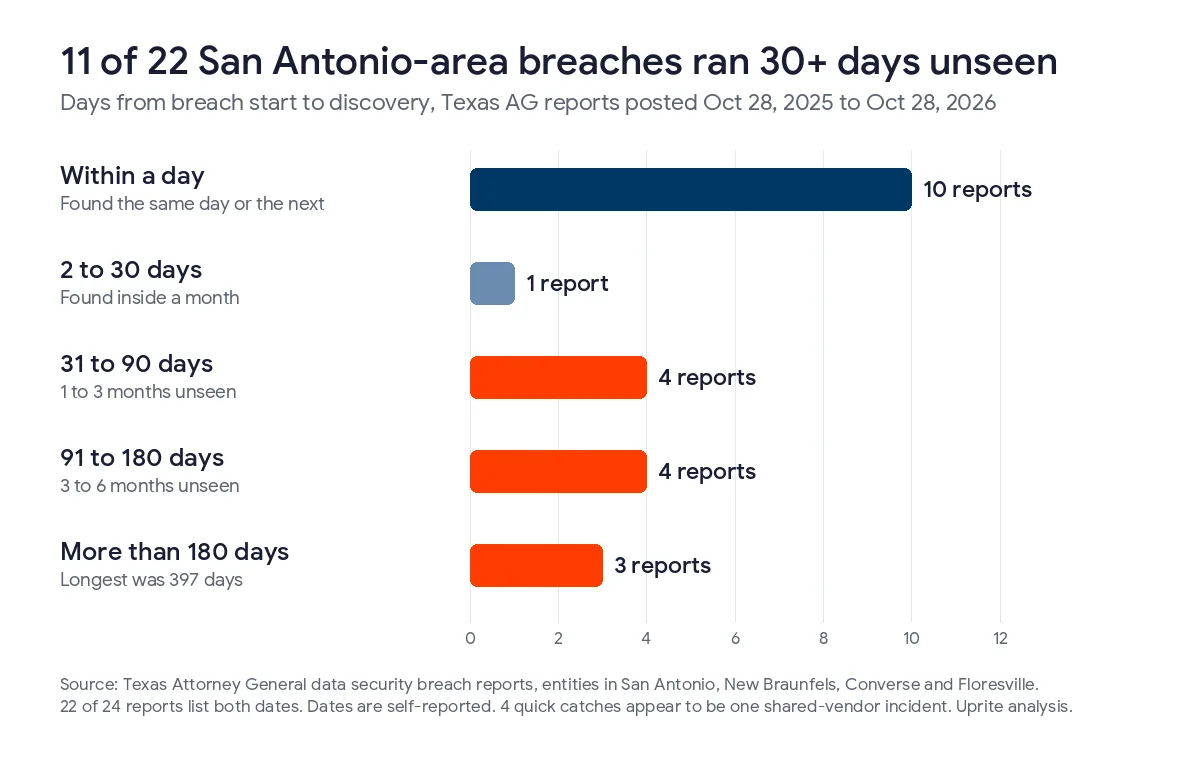
22 of those reports list both the date the breach started and the date it was discovered. 10 were found within a day. 11 ran for more than 30 days, 7 for more than 90, and 3 for more than 6 months. The longest went 397 days. 4 of the quick catches share the same start and discovery dates and look like one incident at a shared vendor, so the fast group is smaller than it seems.
Healthcare providers filed 9 of the 24. Retailers filed 6. Across all 234 Texas reports with both dates in that window, the median gap from start to discovery was 61 days.
Two months. That’s what an unwatched network costs you, on average, before you even know. The dates are the ones each organization gave the AG, so treat them as self-reported. But nobody reports a 397-day gap to look bad.
An MDR contract is supposed to move you into the first group. Whether it does depends on the answers to the questions below.
Questions 1 to 4, who acts and how fast
1. Who can isolate a device or disable an account at 2 a.m. without calling us first?
This one matters more than the rest put together. A good provider names a person on shift, not a platform, and shows you a written list of pre-approved actions. Isolating a laptop from the network. Disabling a Microsoft 365 account. Killing a running process. Revoking sign-in sessions. If every one of those needs your approval first, and your approval means waking up your office manager, you’ve bought a very expensive alarm clock.
Ask to see the pre-authorization form. Then ask what they won’t do without you. Shutting down a production server or blocking a whole office is a fair line for them to hold.
2. How do you measure response time, and where does the clock stop?
Response time is the easiest number in this business to dress up. Acknowledging an alert, starting an investigation and containing a threat are 3 different clocks, and only the last one protects you. Ask for each one by severity level, measured over the last 12 months, across all their clients. Then ask what you get back when they miss it.
For reference, Uprite’s average response time is 5 minutes. That’s our number to hold us to, and you should hold any vendor to theirs the same way.
3. What do you watch besides laptops and servers?
Endpoint-only MDR misses the attacks that never touch an endpoint. 2,253 Texans reported business email compromise to the FBI in 2025, with $304,318,015 in losses, according to the IC3’s 2025 Texas state report. In the cases we get called into, it usually starts with a stolen Microsoft 365 password, not malware on a laptop.
So ask for the list. Entra ID sign-ins, mailbox forwarding rules, firewall and VPN logs, cloud apps like Google Workspace or QuickBooks Online. CISA’s event logging guidance from August 2024 puts centralized log collection and a written detection strategy at the center of catching attackers who use your own admin tools against you. An MDR provider should be able to say which of your logs they ingest and which they don’t. Gaps are fine. Hidden gaps aren’t.
4. Whose analysts staff the SOC overnight, and where are they?
Some providers run their own security operations center. Others resell a white-label SOC and put their logo on the reports. Neither is automatically bad, but you should know which one you’re buying, because the person reading your alert at 3 a.m. works for whoever runs that SOC.
Ask how many analysts are on shift overnight, whether they’re US-based, and how many clients each one covers. San Antonio has about 1,350 information security analysts in total, per BLS May 2025 estimates, with Joint Base San Antonio and the 16th Air Force hiring from the same pool. A local provider claiming a big in-town night shift deserves a follow-up question.

Questions 5 to 8, tools, escalation and money
5. Do we keep our current EDR tool, or do we have to switch?
Some MDR services only work on the provider’s own agent. Others run on what you already own, like Microsoft Defender for Business, CrowdStrike Falcon or SentinelOne. Switching isn’t a dealbreaker. Paying twice for overlapping agents for a year is, so ask about the cutover and who removes the old one.
6. Who do you call, in what order, and what happens if nobody answers?
Get the call tree in writing. 3 names, 3 phone numbers, and a rule for what the analyst does if all 3 go to voicemail at 2 a.m. on a Sunday. If the answer is that they keep trying and send an email, go back to question 1, because the threat keeps moving while they dial.
We rebuild a client’s call list every time someone leaves, and it’s the item that drifts out of date fastest. Ask how often your provider tests theirs.
7. What happens after containment, and is it billed separately?
Containment stops the spread. It doesn’t tell you what was taken, clean up the persistence an attacker left behind, or rebuild the server. NIST’s SP 800-61 Revision 3, published in April 2025, treats detect, respond and recover as one incident response cycle, and plenty of MDR contracts only cover the first piece and a half.
Ask whether forensic investigation and recovery hours are included, capped, or billed hourly. Ask whether they’ll work with the incident response firm your cyber insurer assigns, because a lot of policies pick that firm for you. Our sibling guide on cyber insurance monitoring requirements in San Antonio covers what carriers have started asking for.
8. How are you priced, and what isn’t in the per-seat number?
MDR is usually sold per endpoint, per user, or by data volume. The headline number rarely includes the EDR license, extra log sources, incident response hours or onboarding. Ask for a quote on your actual headcount with every line item shown, and compare totals, not rates. We break down what MDR costs in San Antonio in a separate guide.
Bias disclosed, we sell this. Uprite’s MSSP Security Focus plan starts at $40 per user per month and covers SIEM and SOC monitoring, firewall management, vulnerability scanning, threat intelligence and incident response, with licensing on top. Our managed security plans page lists what’s in it.
Questions 9 to 12, paperwork, data and the exit
9. Will your incident report give us the dates Texas breach law runs on?
Texas gives you 60 days from the date you determine a breach happened to notify affected people, and 30 days to notify the Attorney General when 250 or more Texans are involved, under Section 521.053 of the Business and Commerce Code. Your lawyer will want a timeline that shows when the activity started, when it was detected, and what was touched. The MDR provider is usually the only party holding that evidence.
There’s a second Texas reason. Senate Bill 2610, in effect since September 1, 2025, bars exemplary damages in a breach lawsuit against a business with fewer than 250 employees if it can show it ran a qualifying cybersecurity program at the time. What qualifies depends on headcount.
| Your headcount | What the program has to include under SB 2610 | What to ask your MDR provider for |
|---|---|---|
| Fewer than 20 employees | Simplified requirements, including password policies and employee cybersecurity training | Proof that MFA and sign-in alerting are on for every account |
| 20 to 99 employees | Moderate requirements, including CIS Controls Implementation Group 1 | Monthly reports that show which IG1 safeguards they monitor |
| 100 to 249 employees | Conformity with a recognized framework such as the NIST Cybersecurity Framework, NIST SP 800-171 or ISO 27000 | Reports mapped to the framework’s detect and respond functions |
| 250 or more | The safe harbor doesn’t apply | The same evidence anyway, for your insurer and the AG |
It only blocks punitive damages, not actual ones, and it isn’t legal advice from us. Still. A provider whose reports can’t help you prove you had a program is leaving money on the table for you.
10. How long do you keep our logs, and who owns them?
Breaches that run 397 days need logs that go back further than 90. Ask for the retention period in writing, whether it costs extra past a certain window, and whether you can export the raw logs yourself. You own your data. The contract should say so.
11. How do you work with the IT team or provider we already have?
MDR finds problems. Somebody still has to patch the server, reset the firewall rule or replace the laptop. Ask who does that work, how tickets move between the MDR team and your IT people, and who’s on the hook when a fix sits for a week. If you run your own IT, a co-managed arrangement with managed IT in San Antonio or your existing team can close that gap. Firewall and segmentation fixes tend to land on whoever runs your network security services.
12. What does leaving look like?
Ask now, while they want your business. How much notice, what happens to your logs and reports, how fast their agents come off your machines, and when their admin accounts in your tenant get disabled. A provider that gets vague here usually gets vague everywhere else too.
How do you score the answers?
Short version, a good answer is specific and written down. A weak one is a feature name or a promise to follow up.
| Question | A good answer sounds like | A red flag sounds like |
|---|---|---|
| 1. Who acts at 2 a.m. | A named shift role plus a signed list of pre-approved actions | We’ll notify you right away |
| 2. Response time | Acknowledge, investigate and contain times by severity, with 12 months of data | One average with no definition |
| 3. Coverage | A written list of every log source, including Microsoft 365 sign-ins | We cover endpoints and that’s what matters |
| 4. SOC staffing | Own analysts, overnight headcount, US location stated | Our partner handles nights |
| 5 to 8. Tools, escalation, cost | A call tree, an itemized quote and stated incident response hours | Incident response is billed as needed |
| 9 to 12. Paperwork and exit | Timeline reports, stated retention, data export and an offboarding clause | We’ll work that out if it comes up |
Could you staff this yourself instead?
You could. It’s just expensive. A 24/7 seat covers 8,760 hours a year, and one full-time analyst works about 2,080, so keeping one chair filled takes roughly 4.2 people before vacation or sick days.
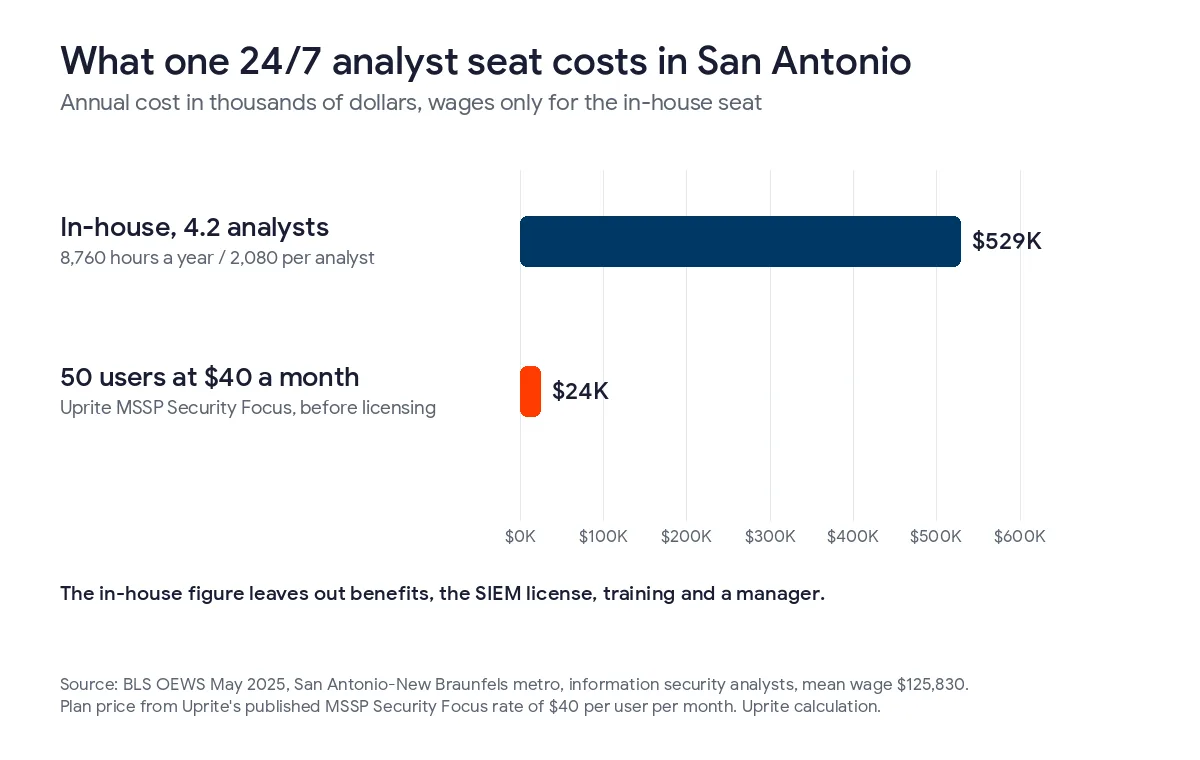
At the San Antonio mean wage of $125,830 for information security analysts in the BLS May 2025 numbers, those 4.2 people cost about $529,000 a year in wages alone, before benefits, the SIEM license, training or the manager who schedules them, and that’s for a single person awake at any given hour with nobody to cover a sick call. For a 50-person company on our $40 plan, the monitoring line comes to $24,000 a year. That gap is why MDR exists.
Companies at 150 seats or more, with a regulated data set and their own security lead, sometimes build a hybrid where internal staff own business hours and a provider covers nights. That’s a fair setup. Ask the same 12 questions of whoever covers the nights. Our San Antonio cybersecurity services team can help scope where that line falls, and you can compare tiers on our published plan prices before any call.
Questions San Antonio teams ask us about MDR contracts
Is MDR worth it for a 40-person company?
Usually, if you hold customer or patient data and nobody on staff watches alerts at night. 40 users on a $40 per user plan is $1,600 a month, which is far less than one analyst’s salary and a fraction of a single breach notification.
Does it matter whether they call it MDR or MSSP?
Less than people think. What matters is whether someone contains the threat or just forwards you an alert, so ask question 1 regardless of the label.
How long should the first MDR contract run?
12 months is a reasonable first term. Ask for an exit clause tied to missed response targets, and avoid 3-year terms until you’ve lived through at least one real incident with them, because that’s when you learn whether the pre-approved actions actually get used at 2 a.m.
Do we still need our IT provider once MDR is in place?
You do. MDR watches and contains, but patching, user changes, backups and hardware still need an owner, and the handoff between the two teams is where fixes stall.
Will an MDR provider file the Texas AG breach notice for us?
No, and they shouldn’t. The notice is your legal duty, usually handled with counsel, but the provider’s timeline of when the activity started, when it was found and what it touched is the evidence that notice gets built from.
Can MDR stop ransomware on its own?
Not on its own. Fast isolation can stop encryption from spreading past the first few machines, but you still need tested backups, MFA everywhere and patched servers, since MDR buys time and those controls decide how much damage gets done in it.
If you’re comparing MDR providers in San Antonio, bring the quotes to us. We’ll go through all 12 questions against each one with you, ours included, and tell you plainly which answers would worry us.
Talk to a Security Expert