Cyber insurers expect a San Antonio business to run endpoint detection and response on every device, have a person review its alerts around the clock, keep logs in one place, and hold a written incident response plan.
Those 4 items are the cyber insurance monitoring requirements that keep showing up on applications in 2026. I’m Kevin Sitta, VP of Operations at Uprite, and when we set up managed detection and response in San Antonio for a client, the renewal form is often the first document they hand us. This guide walks through the actual monitoring questions on 3 carrier applications and a state underwriting toolkit, what the Texas Attorney General’s breach list says about how long San Antonio breaches go unnoticed, and what it would cost to staff the night shift yourself.
Insurers rarely ask whether you “have monitoring.” They ask whether EDR is on all endpoints, who reviews alerts at night, where logs live and for how long, and whether an incident response plan exists on paper. In the Texas AG’s list for the 12 months to November 6, 2026, 11 of 23 San Antonio-area filers found their breach within a day, and the other 12 took a median of 127 days. That gap is what underwriters are pricing.
What does 24/7 monitoring mean to a cyber insurer?
To an underwriter, 24/7 monitoring means software that watches every laptop, server, and cloud account, plus people who read its alerts at any hour and are allowed to act on them. A tool that records an alert for someone to see on Monday doesn’t meet that bar.
Corvus states it plainly. The glossary on its Smart Cyber Insurance Application, version 3.2 from September 2024, defines Managed Detection and Response as “a third-party organization that provides 24/7 outsourced cybersecurity services like threat hunting, network monitoring, and remediation of detected threats.” EDR, in the same glossary, is security software that performs “real-time continuous monitoring with rule-based automated response.” The software and the people are listed as 2 separate boxes. Underwriters treat them that way too.
The State of Indiana’s cyber insurance underwriting toolkit, which collects typical underwriting questions across 18 control categories, goes a step further and asks “Does the Applicant use a SIEM monitored 24×7 by a SOC?” That’s a yes or no. No partial credit.
The monitoring questions on real applications
We read the monitoring sections of 4 documents an underwriter might put in front of a San Antonio business. Here’s what each one asks, in its own words, and what a truthful yes has to rest on.
| Source | What it asks | What a yes needs behind it |
|---|---|---|
| Indiana Cybersecurity Hub underwriting toolkit | “Does the Applicant use advanced endpoint detection and response (EDR) tool on all endpoints?” | An agent count that matches your device count, including laptops that rarely come to the office |
| Indiana Cybersecurity Hub underwriting toolkit | “Does the Applicant use a SIEM monitored 24×7 by a SOC?” | A contract naming the security operations center and the hours it covers |
| Corvus Smart Cyber Application v3.2, question 13 | Which endpoint security technology is in place, with a request to “list the product and vendor” | The product name and the company running it, written down |
| Beazley InfoSec Application | Whether you outsource “Managed Security” or “Alert Log Monitoring,” and to which vendor | The vendor’s name and a signed agreement |
| Beazley InfoSec Application | Whether logs are collected centrally and “For how long are logs maintained?” | A retention setting you can show, in days or months |
| Calsurance cyber application, question 9 | How long it would take to become fully operational after a disruption, from 1-4 hours to 48+ hours | A tested recovery time, not a guess |
Notice what’s missing. None of these forms asks for a brand of firewall or a particular SIEM product. They ask who is watching and what they can prove. Corvus and the Beazley InfoSec form both want the vendor’s name, which means an underwriter can check it. The Calsurance application skips products entirely and asks for a recovery time band.
The NAIC’s 2025 cyber insurance market report adds the market view. Companies kept investing in security controls, “which is looked upon favorably by underwriters,” according to the report. It doesn’t promise a discount for any single control, and neither will we.
How long San Antonio breaches go unnoticed
We pulled the Texas Attorney General’s data breach list, which publishes every notice affecting 250 or more Texans, and kept the 276 filers based in Texas that were posted between November 7, 2025 and November 6, 2026. Then we cut it to the San Antonio metro, including Windcrest, Converse, Floresville, and New Braunfels.
25 San Antonio-area organizations filed in that window, covering 331,653 Texans. 23 of them gave both a start date and a discovery date. 11 of the 23 reported finding the breach the same day it started or the next day. The other 12 took between 26 and 397 days, with a median of 127.
There’s a caveat on the fast group. 4 of those 11 were dental and medical offices that reported the identical start and discovery dates in May 2026, which looks like one shared vendor incident rather than 4 separate wins. And filers enter these dates themselves, so treat the numbers as directional.
Statewide, the picture is slower. Across the 232 Texas filers with both dates, the median gap was 61 days, and 91 of them took longer than 90 days to notice.
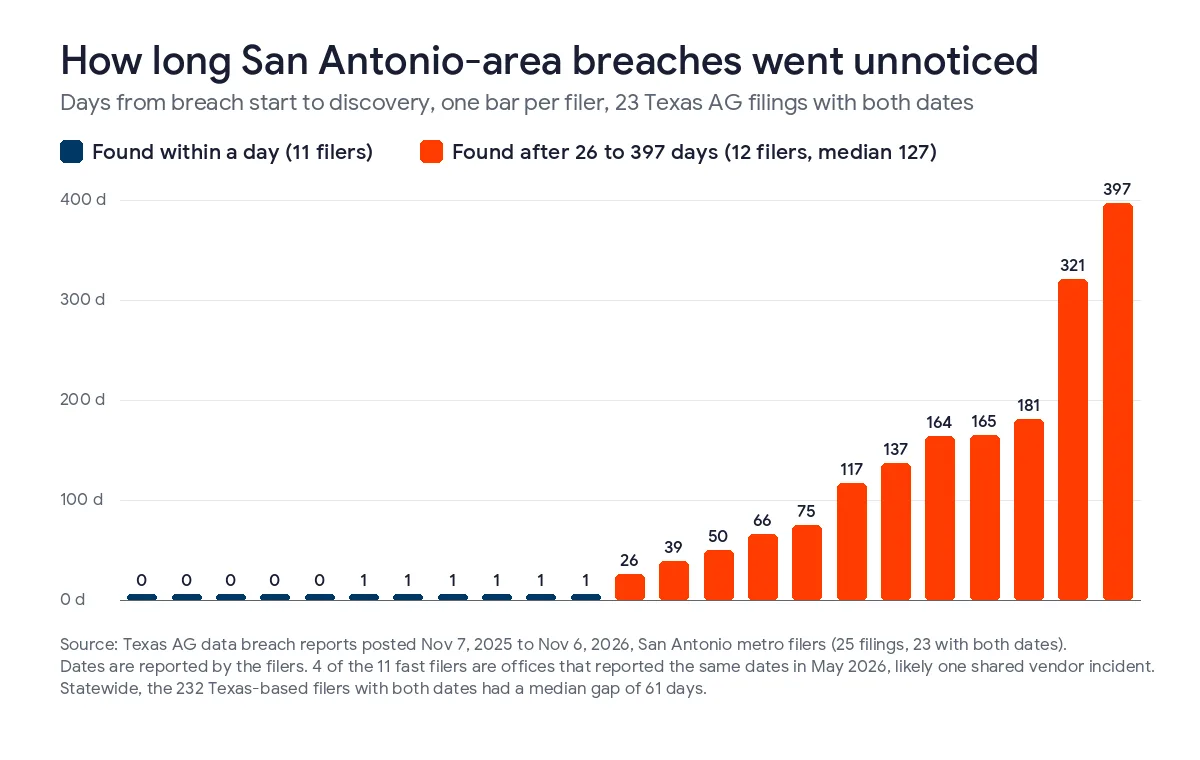
That split is the whole argument for watching alerts at night. A breach found the next morning is usually one laptop or one mailbox. A breach found 4 months later has had time to reach backups, payroll, and patient records. Healthcare was the largest group in the San Antonio cut, with 9 of the 25 filings.
What it costs to staff overnight monitoring in San Antonio
Some owners read the insurer’s question and decide to hire. The math gets heavy fast.
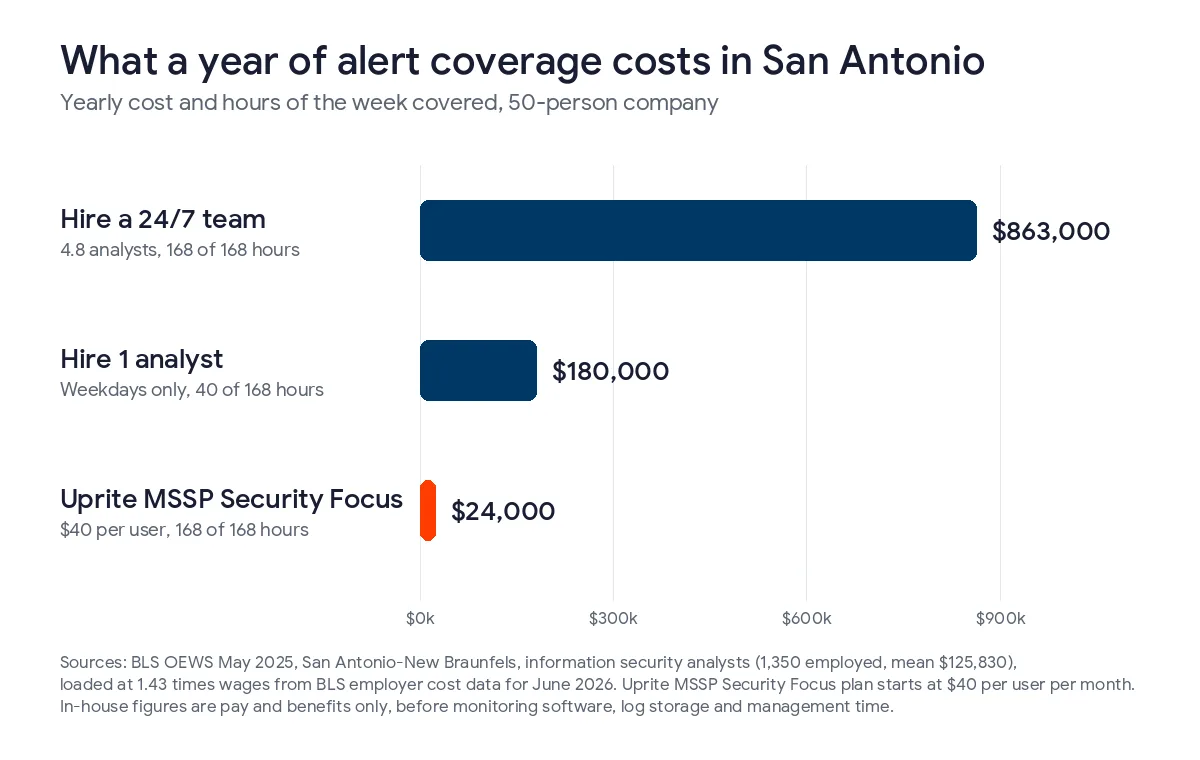
The Bureau of Labor Statistics counted 1,350 information security analysts in the San Antonio-New Braunfels metro in May 2025, earning a mean of $125,830 a year. BLS employer cost data for June 2026 puts total compensation at about 1.43 times wages for private industry, so each analyst costs roughly $180,000 once benefits and payroll taxes are added. A week has 168 hours, so round-the-clock cover needs 4.2 full-time people on paper and about 4.8 in practice, after vacations, sick days, and training come out.
| Approach | Yearly cost | What the insurer sees |
|---|---|---|
| Hire 4.8 analysts at San Antonio pay | About $863,000 in pay and benefits, before tools and log storage | An in-house SOC, if you can keep it staffed |
| 1 in-house analyst on days | About $180,000 | 128 hours a week with nobody reading alerts |
| Uprite MSSP Security Focus plan for 50 users at $40 per user per month | $24,000 | A named SOC with monitoring and incident response included |
A 50-person accounting firm or clinic would be competing for those same 1,350 people with every larger employer in town, and night shifts are the hardest seats to fill. Our cybersecurity cost guide for San Antonio breaks down the rest of a San Antonio security budget. The MDR cost breakdown for San Antonio goes deeper on per-user rates. The Security Focus plan sits inside our managed security services, and every plan’s current rate is listed on our pricing page.
Where alert-only coverage leaves you on the form
Here’s the part of our own price list I’d rather be upfront about. Uprite’s IT Essentials plan, which we sell to remote teams of fewer than 12 people, raises alerts but has no one responding after hours. That’s fine for a tiny office with little sensitive data. It doesn’t let you answer yes to “a SIEM monitored 24×7 by a SOC,” and no alert-only plan from any provider should.
EDR without people has the same problem. The license blocks known malware on its own, but a stolen password used at 1 a.m. on a Saturday looks like a normal login until a person compares it with that employee’s usual pattern. If nobody is assigned to that review, the honest answer to Beazley’s “Alert Log Monitoring” question is that nobody does it.
Why does the wording matter so much? Because the application becomes part of the policy. In Travelers v. International Control Services, a 2022 federal case in Illinois, the insurer asked a court to rescind a policy after a ransomware claim because the company had attested to multifactor authentication it hadn’t fully deployed, and the policy was rescinded by agreement. Our guide to cyber insurance requirements covers that case and the other controls carriers ask about.
How long should you keep logs?
Beazley asks the question directly and doesn’t supply an answer, so you need one before you fill in the blank.
CISA’s Cross-Sector Cybersecurity Performance Goals, version 2.0 from December 2025, merged log collection and storage into goal 3.Q. It says logs should be “stored in a central system, such as a security information and event management tool or central database,” kept for “a duration informed by risk or pertinent regulatory guidelines,” and that security teams should be “notified when a critical log function is disabled.” That last line matters, since attackers often switch logging off first.
For a number, the closest federal benchmark is OMB memo M-21-31 from August 2021, which sets most high-priority federal agency logs at 12 months of active storage plus 18 months of cold storage. It binds federal agencies, not private companies. We use it as a reference point. A San Antonio clinic or law office that can pull 12 months of sign-in and endpoint logs on request is in a strong spot when the underwriter asks, and a firm whose Microsoft 365 audit log holds only the default window is not.
The joint logging guidance CISA co-published with Australia’s ACSC, the FBI, and NSA in August 2024, Best Practices for Event Logging and Threat Detection, makes the same point from the attacker’s side. Default retention periods are often too short to investigate an intrusion that started months earlier, which is exactly the San Antonio pattern above.
The Texas clock that starts at discovery
Texas Business and Commerce Code section 521.053 gives a business 60 days from the date it determines a breach occurred to notify affected individuals. If 250 or more Texans are involved, the Attorney General has to be told within 30 days, through the AG’s online form.
Both clocks start at discovery. That sounds like it rewards finding out late. It doesn’t. A breach found after 127 days usually comes with 127 days of activity to reconstruct, and without stored logs nobody can say which records were touched, so the notice goes to everyone.
Texas SB 2610, which applies to breach lawsuits that arise on or after September 1, 2025, adds a reason to keep a framework-based program. A business with fewer than 250 employees that follows a recognized framework such as the NIST Cybersecurity Framework can’t be ordered to pay exemplary damages after a breach. Continuous monitoring sits inside that framework’s Detect function. Our Texas SB 2610 compliance checklist lays out the tiers by company size.
What to have ready before your next renewal
Gather these 6 items before the application arrives. Each one maps to a question above.
- The EDR product name, the vendor, and a current agent count compared with your device list
- The name of the company watching alerts after hours, and the contract page that states 24/7 coverage
- One recent monthly monitoring report showing alerts that were investigated and closed
- Your log retention setting for Microsoft 365, endpoints, and the firewall, written in days or months
- Your incident response plan, with the date it was last reviewed and the names of the people on the call list
- Your measured recovery time from the last restore test, so the Calsurance-style question gets a real answer
If you can’t produce item 2 or item 3, the monitoring question is where your application is weakest. The questions to ask an MDR provider in San Antonio help sort a real SOC from a reseller. Our EDR vs MDR vs XDR comparison explains which of those labels an insurer actually counts, and if the same underwriter is also asking about testing, see whether cyber insurance requires a pen test in San Antonio.

Questions San Antonio owners ask about monitoring and cyber insurance
Do cyber insurers require 24/7 monitoring in San Antonio?
Not every carrier makes it a condition, but the forms ask about it directly. Indiana’s underwriting toolkit lists “Does the Applicant use a SIEM monitored 24×7 by a SOC?” and Corvus defines MDR as 24/7 outsourced monitoring. A no usually means more questions, a higher retention, or a lower limit.
Is EDR alone enough for the application?
Usually not. EDR answers the endpoint question, but the separate questions about who reviews alerts and which vendor does it still need a person behind them.
How long should we keep security logs for an insurer?
12 months is a defensible floor for most San Antonio businesses. CISA’s performance goals say retention should follow risk and regulation, and the federal benchmark in OMB M-21-31 is 12 months active plus 18 months in cold storage. Check whether your Microsoft 365 license keeps audit logs that long by default.
What happens if we answer a monitoring question wrong?
The insurer can contest a claim or seek to rescind the policy, because the application is part of the contract. That’s what happened in Travelers v. International Control Services in 2022 over multifactor authentication. If you aren’t sure an answer is true, ask your provider for the evidence before you sign.
Can our in-house IT person cover the requirement?
Only during the hours that person works. One full-time employee covers about 40 of the week’s 168 hours, so nights and weekends stay unwatched unless a provider takes them. A common setup keeps the in-house person on days and hands nights, weekends, and holidays to an outside SOC.
What does 24/7 monitoring cost a San Antonio company?
Our MSSP Security Focus plan starts at $40 per user per month with SOC monitoring and incident response included, so a 50-person company pays about $2,000 a month. Building the same coverage in-house at San Antonio analyst pay runs about $863,000 a year.
Send us the monitoring section of your last cyber insurance application. We’ll tell you which answers your current setup can back up with evidence, which ones it can’t, and what it would cost to close the gap before renewal. Our average first response is 5 minutes.
Get a Monitoring ReviewPrefer to email or call? Reach the team through our contact page.