
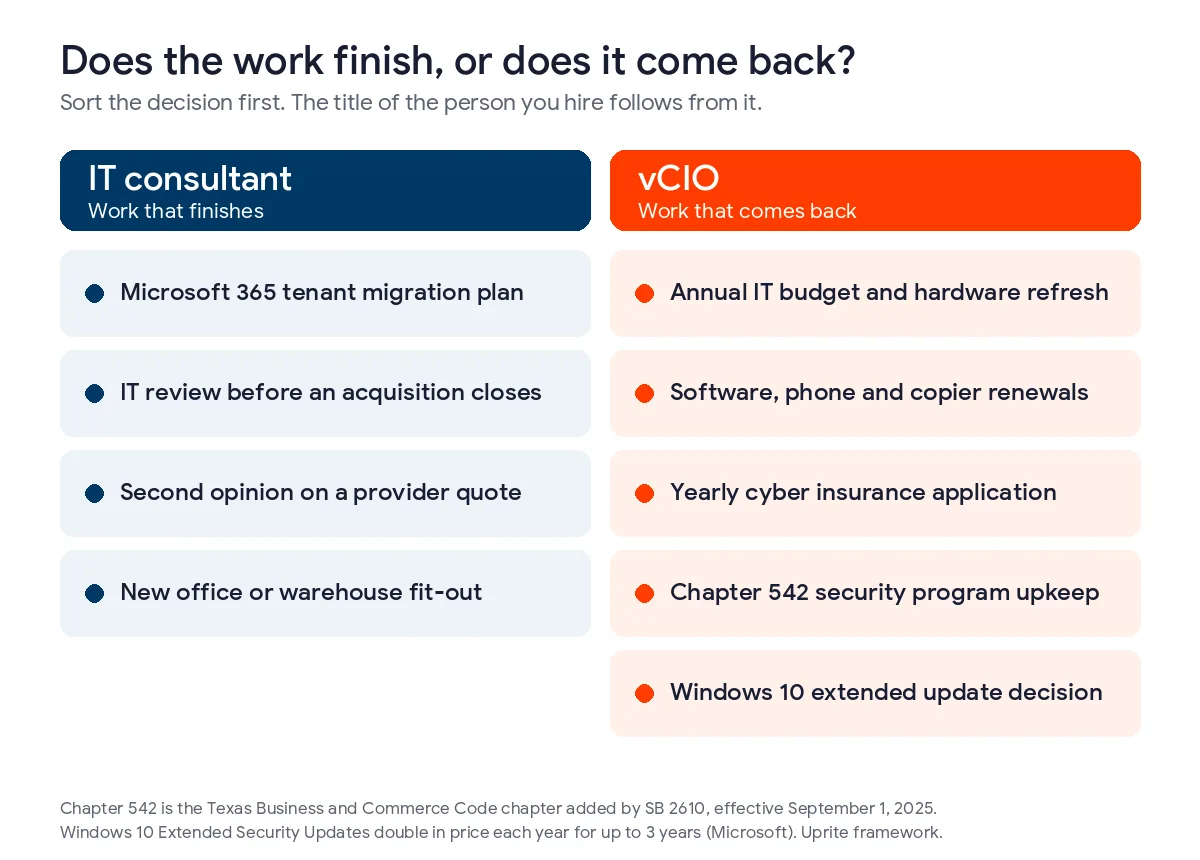
A Houston company usually needs an IT consultant for a single scoped project, such as a migration or an acquisition review, and a vCIO for decisions that come back every year, such as budgets, renewals, and Chapter 542 upkeep.
Uprite sells both services, and this post sits under our main page on IT strategy consulting in Houston. Owners in Katy, around the Galleria, and out along the Energy Corridor usually put the question to us as a choice between 2 job titles. It’s easier to answer as a question about month 7. By then the consultant’s report is filed away in SharePoint, the person who wrote it is working for somebody else, and the renewals and budget calls it predicted are showing up on schedule. Below we go through 9 situations that come up in Houston, the public BLS and GSA numbers on cost, the Texas statute passed in 2025 that changes things for companies under 250 employees, and the cases where we’d point a company toward an independent consultant instead.
Hire an IT consultant when the work has a scope you can write down in advance and a visible end, as with a Microsoft 365 migration plan, a pre-acquisition IT review, or a second look at a quote. A vCIO handles what comes around each year, meaning the budget, software renewals, the Windows 10 Extended Security Updates invoice, and upkeep of the program Texas Business and Commerce Code Chapter 542 expects. Plenty of Houston firms hire a consultant first, then a vCIO.
What’s the difference between a vCIO and an IT consultant?
An IT consultant is brought in from outside to answer a question the client has already defined, for a fee and on a timeline agreed up front, and the job is over when the client signs off on the deliverable. A vCIO (virtual chief information officer) is a part-time executive who holds a company’s technology roadmap and budget and makes or recommends the vendor calls, often for years.
The Bureau of Labor Statistics doesn’t count vCIOs or IT consultants as occupations of their own. Senior technology leaders are filed under computer and information systems managers, and the BLS occupational profile for that group says people in it may hold titles such as chief information officer or chief technology officer. A vCIO does that job on a part-time schedule. A consultant on a single project generally isn’t filling that role in any sense the BLS would recognize.
| Factor | IT consultant | vCIO |
|---|---|---|
| Who defines the question | The client, in the statement of work | Worked out each year with the owner and leadership |
| How the engagement ends | Sign-off on the final deliverable | It continues, with a review every quarter |
| Usual output | A report, a network diagram, or a vendor shortlist | A roadmap and budget, revised quarterly |
| Accountable afterward | Whoever on staff inherits the report | The vCIO, in front of leadership |
| Billing | Hourly, or a fixed fee quoted after scoping | Monthly, or folded into a managed IT contract |
| Knowledge of past decisions | Limited to the files left behind | Carried from one review to the next |
| Common uses | Migrations, acquisitions, office moves, second opinions | Budgets, renewals, cyber insurance, Texas compliance upkeep |
That row about past decisions is where the money goes. Bring a consultant back after 12 months and they’ll usually start by re-interviewing staff and redoing the asset inventory, and those hours get billed again. A vCIO who sat through last spring’s cyber insurance renewal already knows what the application said about things like multifactor authentication and backups, and which controls were promised by what date.
Which one fits the decision in front of you?
We find it easier to sort by the decision than by the title. Here are 9 situations from Houston clients, grouped by whether the work finishes or keeps coming back.
| Situation | Better fit | Why |
|---|---|---|
| Planning a one-time Microsoft 365 tenant migration | IT consultant | Scope and end date are known before work starts |
| Reviewing a target company’s IT before an acquisition closes | IT consultant | Independent, time-boxed, and finished at closing |
| Getting a second opinion on a managed IT or cabling quote | IT consultant | You want someone with nothing to sell you afterward |
| Fitting out a new office or warehouse in the Energy Corridor or Cypress | IT consultant | It’s a project with a fixed move-in date |
| Annual IT budget and hardware refresh planning | vCIO | It returns every year and builds on last year’s numbers |
| Software, phone, and copier contract renewals | vCIO | Renewal dates are spread across the year and someone has to watch them |
| The yearly cyber insurance application | vCIO | Answers have to match last year’s and what’s really in place |
| Keeping a Chapter 542 cybersecurity program current | vCIO | The statute protects a program that was implemented and maintained |
| Windows 10 PCs still on extended security updates | vCIO | Microsoft doubles the price each year, so the decision returns every November |
A few of these overlap. Moving a 60-person firm onto a new Microsoft 365 tenant is consultant work with a start and finish, yet after cutover someone has to keep reviewing licenses, guest access, and SharePoint sharing links every month. In Houston companies with 20 to 200 employees, the migration usually goes to plan and the follow-up is where ownership quietly lapses.
Why does Texas law make upkeep the hard part?
Senate Bill 2610, effective September 1, 2025, added Chapter 542 to the Texas Business and Commerce Code. It applies to businesses with fewer than 250 employees, and it bars a person harmed by a breach from recovering exemplary damages if the business shows that, at the time of the breach, it “implemented and maintained” a cybersecurity program meeting the chapter’s requirements.
Those requirements are tiered by headcount. Businesses under 20 employees face simplified requirements, password policies among them. From 20 to 99 employees the statute names the Center for Internet Security Controls Implementation Group 1, and from 100 to 249 it expects full compliance with a recognized framework such as the NIST Cybersecurity Framework, whose 2.0 version files strategy, roles, and oversight under a separate Govern function.
Section 542.004(c) is the part that matters for this comparison. When one of those frameworks is updated, the business has until the later of the framework’s own implementation date or the first anniversary of its publication to bring the program in line. A consultant can draft a sound program in about 6 weeks, but under a project engagement no one at the consultancy is assigned to track the next CIS or NIST revision once the final invoice has been paid.
Breach reporting belongs with the same person, since the Texas Attorney General requires notice within 30 days of discovering a breach that affects 250 or more Texans.
Windows 10 Extended Security Updates as an example
Windows 10 reached end of support on October 14, 2025. Microsoft’s Extended Security Updates page gives the commercial price as $61 per device for Year One, says the price doubles every consecutive year, and caps the program at 3 years. According to the same page the updates are cumulative, which means a business that enrolls in Year Two also pays for Year One.
Run that against a hypothetical office with 40 PCs still on Windows 10 (our arithmetic, not Microsoft’s). Year Two is $122 a device, which comes to $4,880 for the 40. If the company skipped Year One, catching up costs $183 a device, or $7,320. Microsoft started the Year One clock in November 2025, which puts Year Two pricing in effect this month. The advice to replace those PCs was easy enough to give in 2024. Where it tends to fall apart is the follow-through, because somebody has to fit the replacements into the 2027 budget and keep count of the machines that haven’t been swapped yet.
What does each one cost in Houston?
Firms quote very differently for the same work, so we started from public data.
Hiring the role full time is the ceiling. The BLS puts the annual mean wage for computer and information systems managers in the Houston metro at $182,200 in May 2025, across 13,090 jobs. Benefits and payroll taxes add about 43% for private employers, going by the June 2026 Employer Costs for Employee Compensation release. That puts a Houston CIO near $260,500 a year before recruiting fees or a bonus.
Outside advice is priced by the hour or the month. The federal government’s CALC labor rate database is one of the few public sources of negotiated rates. When we pulled it on November 9, 2026, the 1,021 rates for IT consultant titles without a security clearance, from 328 vendors, had a median of $148.36 an hour, with the middle half between $122.81 and $181.30. CIO-level titles are rarer. There were 11 rates from 10 vendors, some of them labelled virtual CIO, and their median was $245.19.
Those are ceiling rates on federal contracts, so treat them as a reference point and not a Houston price list. For comparison, Houston management analysts earned a mean wage of $54.09 an hour in May 2025, and any consulting firm has to bill well above wages to cover benefits, overhead, and unbilled time.
| Option | How it’s priced | Rough annual cost |
|---|---|---|
| Full-time Houston CIO | Mean wage plus about 43% for benefits and taxes | About $260,500 |
| Consultant assessment, small | 40 hours at the $148.36 CALC median | About $5,900 |
| Consultant assessment, mid-size | 80 hours at the same rate | About $11,900 |
| Consultant assessment, complex | 120 hours, often multiple sites or compliance mapping | About $17,800 |
| Standalone vCIO | $3,000 to $10,000 a month, the common Houston add-on range | $36,000 to $120,000 |
| vCIO inside managed IT | Included in the per-user rate | No separate line item |
The 40, 80, and 120 hour figures are our own planning assumption and did not come from a survey. Dividing the standalone vCIO band by the CALC median for CIO-level titles, $245.19, gives about 12 hours a month at $3,000 and about 41 hours at $10,000. For our clients, that range is roughly what it takes to run a quarterly review, put together next year’s hardware plan, and handle the renewals that land in between (Microsoft 365, the firewall subscription, the copier lease), and where a given company falls in it depends on its size and on how much is changing that year.
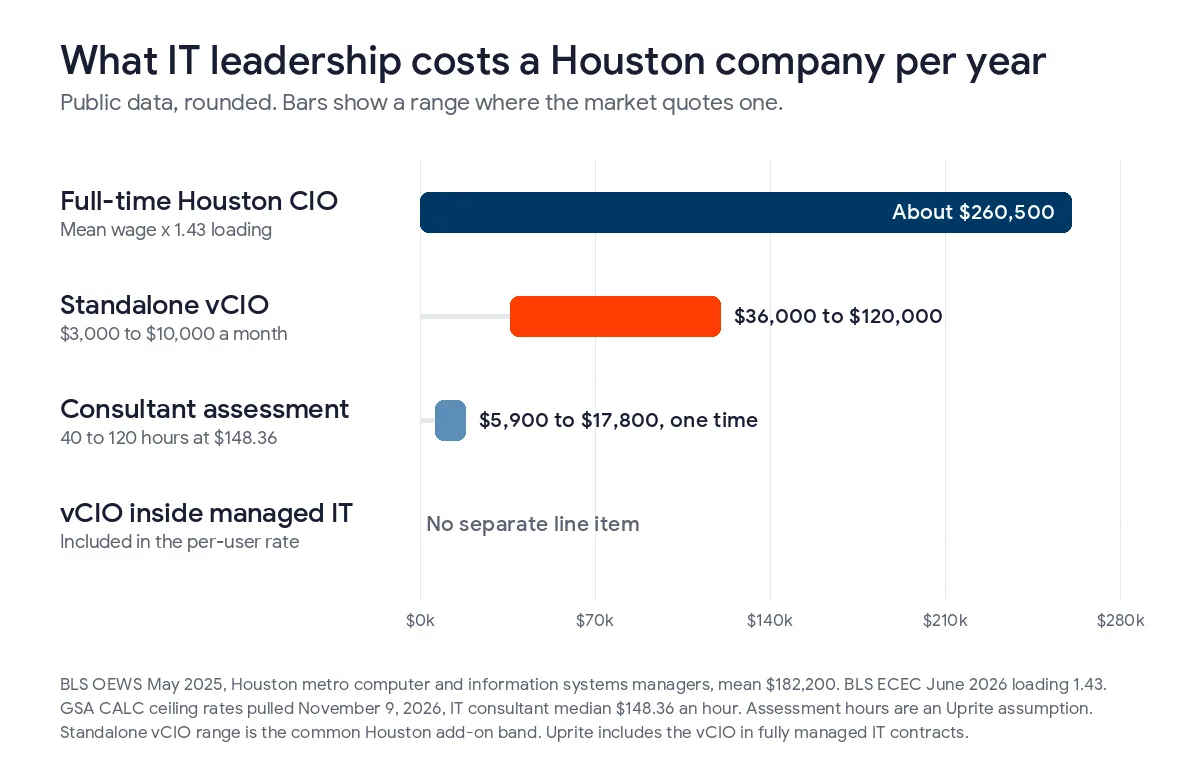
On an hourly basis the consultant looks cheaper, but that comparison leaves out repeat discovery. Every new engagement spends some of its hours relearning the environment, and a company that calls a consultant back 3 or 4 times a year can end up paying in the vCIO range with nobody carrying the plan from one visit to the next.
When is a consultant the better choice?
I’m the CTO of a managed IT provider that includes a vCIO in its contracts, so my interest in this question is plain, and I’d still send a Houston owner to an independent consultant in at least 4 situations.
- Your current provider (that includes us) has sent a proposal for new firewalls or a new support plan, and you want it read by someone who isn’t bidding.
- There’s already a capable IT director on staff, and the gap is 1 specialty, say a network redesign for a second warehouse or a choice between ERP systems.
- A buyer or seller needs the target’s IT reviewed before the closing date.
- You’re about to sign a 3-year agreement with any provider and want the roadmap checked by someone who won’t be implementing it.
That first case is where independence is worth paying for. A vCIO on a managed provider’s payroll has a commercial interest in which firewall, backup platform, or support plan gets picked. The good ones say so up front and put the alternatives on the table, and an outside consultant with no implementation work to win doesn’t have that interest to disclose.
The logic stops holding at some point. If a company has paid the same consultant for similar problems 3 times in 18 months, the recurring bill is usually a sign that no one owned the plan between visits, and owning it is the job a vCIO is hired to do.
Can you start with one and move to the other?
Yes. Among the Houston companies we talk to, it’s probably the usual order. They pay for a scoped assessment, get a written roadmap back, and a few months later find out nobody on staff has the time to carry it. We set up our IT consulting services with that in mind. Our fixed-fee assessment runs about 4 to 6 weeks, and the client keeps the assessment, roadmap, budget, and gap register whether or not they hire Uprite afterward.
A company that has outgrown project-only consulting will usually recognize more than one of these.
- The last roadmap is more than 9 months old and nobody has touched it.
- Copier leases and software subscriptions keep auto-renewing before anyone looks at them.
- Nobody remembers who filled out last year’s cyber insurance application, or what they said on it.
- Leadership has never seen an IT budget broken out by project and by month.
- If someone asks which framework and version the security program follows, nobody can say for certain.

If 2 or 3 of those sound familiar, the decision is really about who owns the plan. For more detail, our guide to what a vCIO does in Texas goes through the deliverables and a yearly calendar, and our explainer on whether your business needs a vCIO compares the role with hiring a full-time CIO. Questions about engineering leadership fit better with our vCIO and CTO comparison.
How does Uprite handle vCIO and consulting work?
Each of our fully managed IT clients has a dedicated vCIO. Kimberly Ramos, our Lead vCIO, runs that practice, and there’s no separate line item for it on the invoice. The quarter builds toward a business review with the client’s leadership, where we go over roadmap progress, budget, security status, and whatever has changed in the business since the last one. The Houston version is on our page for vCIO services in Houston.
If a managed agreement isn’t the right step yet, a company can start with the fixed-fee assessment. In either setup the person writing the recommendation works for the firm that would carry it out, which keeps the plan tied to what our engineers can actually deliver. There’s more about the wider service on our managed IT services in Houston page, and you can reach the team through our contact page.
Questions Houston owners ask about vCIOs and consultants
Is a vCIO just an IT consultant on a retainer?
Not really, because the 2 are measured differently. A retainer is usually paid so that someone will answer when you call. At a quarterly review a vCIO is expected to show leadership which roadmap items were finished, which slipped, and how spending tracked against the budget.
Can our IT consultant become our vCIO later?
Sometimes, if the firm does ongoing advisory work and the same person who ran your assessment stays assigned to you. Worth asking up front are who attends reviews in year 2, who tracks renewal dates, and whether the hourly rate changes after the project closes.
How many hours a month does a vCIO actually spend on one company?
At the federal CALC median of $245.19 an hour for CIO-level titles, the $3,000 to $10,000 monthly range for standalone vCIO work in Houston comes to about 12 to 41 hours. Fall budget season and large renewals push a month toward the top, and a quiet month in the summer can come in well under it.
Do we need a vCIO if we already have an IT manager?
Often yes, though not as a replacement for the manager. An IT manager who keeps daily operations running may still want outside help building a multi-year budget, negotiating with vendors, or mapping controls to CIS or NIST, and a few vCIO hours a month cover that work. If your IT manager already presents the roadmap to leadership and owns it, project consultants are probably enough.
Who should own a Chapter 542 cybersecurity program?
The statute’s “implemented and maintained” wording and the update deadline in Section 542.004(c) both point toward 1 named owner, either an employee or an outside adviser. That person keeps evidence that the program was running at any given date and applies CIS or NIST updates before the later of the framework’s implementation date or the first anniversary of its publication.
Should our vCIO come from our managed IT provider?
There’s a tradeoff either way. A provider’s vCIO knows the environment in detail and can get changes made quickly but has a stake in purchases, while an independent vCIO is more neutral and has to route every change through the provider. With a provider’s vCIO, ask for the roadmap and budget in writing and keep the right to take both elsewhere.
Not sure whether your next IT decision is a one-time project or a standing job? Send us the list of what’s coming up this year and we’ll sort it with you, consultant work on one side and vCIO work on the other. We usually reply within 5 minutes.
Talk to a vCIO