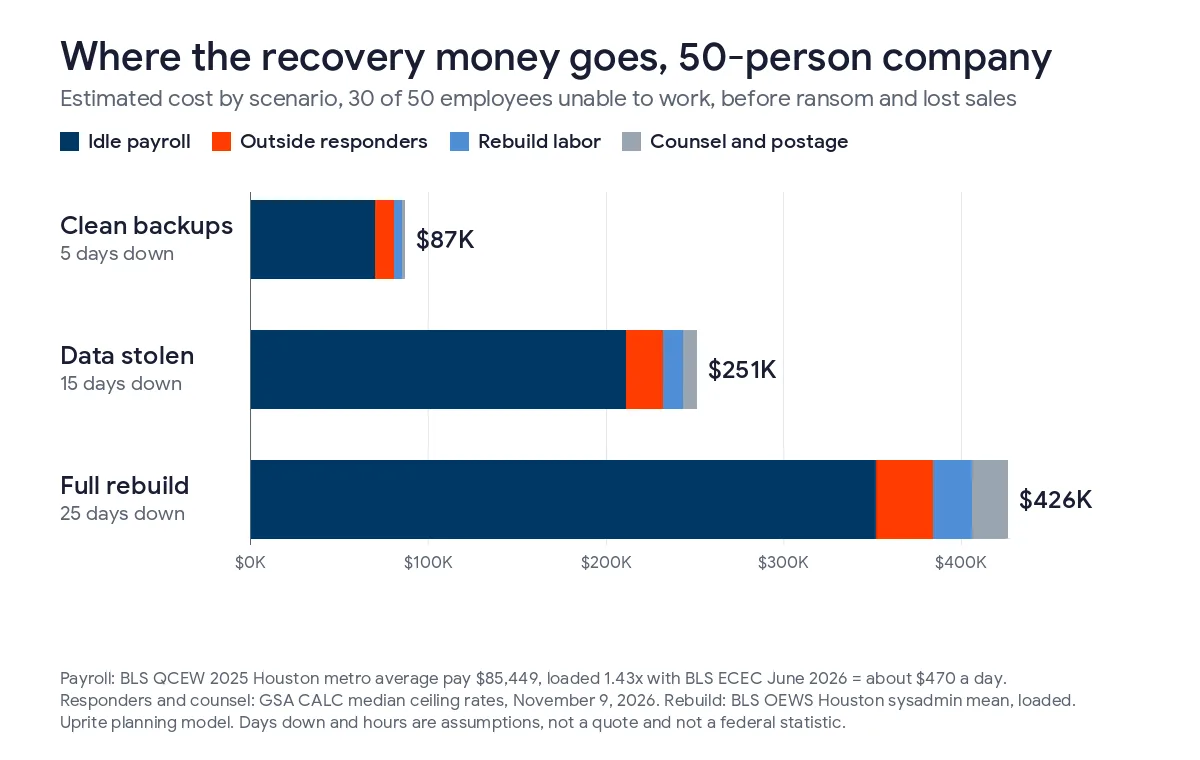
A ransomware attack on a 50-person Houston company costs roughly $87,000 to $426,000 to recover from, by our model, before any ransom, lost sales or insurance deductible. About 4 of every 5 of those dollars are payroll for people who can’t work while systems are down.
I’m the CEO of Uprite. When an owner asks me what an attack would cost, they usually mean the ransom, and that’s the wrong place to start, because the ransom is a choice you may never make while the downtime arrives whether you like it or not. Our page on ransomware incident response in Houston covers how a response runs. This guide covers the bill.
Here’s the short version. A Houston worker costs about $470 a day in loaded payroll, so 30 idle people cost about $14,000 a day. A clean restore in 5 working days lands near $87,000. A 15-day recovery with stolen data lands near $251,000. A full rebuild over 25 days lands near $426,000. Responders, lawyers and postage make up less than a fifth of each total.
What Does Ransomware Recovery Cost a Houston Business?
Ransomware recovery cost is everything a company spends from the moment files lock until it’s running normally again. That covers wages paid to staff who can’t work, outside responders, the labor to rebuild servers and laptops, legal advice, and notice letters if personal data left the building. The ransom sits on top. Paying it is optional.
Most published averages don’t describe a Houston company with 50 people, because they come from surveys of large firms in many countries or they lump every kind of breach together, so we built the number from the bottom up using federal wage data for the Houston metro and federal contract rates for the outside help. Every input is public. Swap in your own.
| Scenario, 50 employees, 30 unable to work | Working days down | Estimated cost | Share that is idle payroll |
|---|---|---|---|
| Clean, tested backups and no data stolen | 5 | About $87,000 | 81% |
| Partial backups, data stolen, 2,250 Texans notified | 15 | About $251,000 | 84% |
| Rebuild from scratch, 10,581 Texans notified | 25 | About $426,000 | 83% |
The days are our assumption. No government source publishes how long a small Houston company stays down after an attack. The notice counts are real. They’re the median and the upper quartile of actual Houston breach filings, which I’ll get to below.
Where Does the Money Go?
Payroll goes first. When file shares, email and the line-of-business system are locked, most of the office can’t do its job, and you still owe every paycheck on the normal schedule. The Bureau of Labor Statistics puts average annual pay across the Houston metro at $85,449 for 2025, across 3,293,797 jobs, in its Quarterly Census of Employment and Wages. Call it $329 per working day.
Wages aren’t the whole cost of an employee, and the gap is bigger than most owners guess. BLS Employer Costs for Employee Compensation data for June 2026 shows private employers paying $46.89 an hour in total compensation against $32.82 in wages. Benefits add about 43%. So an idle Houston employee costs about $470 a day. Thirty of them cost about $14,000.
Then comes the rebuild. Someone has to wipe and reimage every laptop, restore the servers from whatever backups survived, check that nothing the attackers left behind is still running, and reset hundreds of passwords across email, remote access and every business application. In the May 2025 metro wage estimates, Houston’s 6,330 network and computer systems administrators averaged $108,200 a year. Loaded cost is $74 an hour.
We assumed 60 hours of that work for a clean restore. A messy one takes 150. A full rebuild takes 300. Even at 300 hours, the rebuild labor comes to about $22,300, which is less than 2 days of idle payroll for a 50-person firm.
Why Does Downtime Outweigh Everything Else?
It multiplies. The responder’s invoice grows with the size of the network, but idle payroll grows with every person and every day, and those two numbers multiply each other in a way no single vendor bill can match. Here’s what 15 working days of downtime costs at different sizes. We assumed 6 in 10 people can’t work.
| Employees | Unable to work | Idle payroll per day | Idle payroll over 15 days |
|---|---|---|---|
| 25 | 15 | $7,043 | $105,647 |
| 50 | 30 | $14,086 | $211,294 |
| 100 | 60 | $28,173 | $422,589 |
| 200 | 120 | $56,345 | $845,177 |
That leaves out lost sales. For many firms it’s the larger number. A contractor who can’t send invoices, a clinic that can’t schedule patients or a distributor that can’t ship orders loses revenue that a payroll figure never shows, so add your own gross margin per day to get closer to the real cost. Our guide to the cost of IT downtime walks through that calculation.
For an owner the takeaway is practical. Every day you cut from recovery saves about $14,000 at 50 people. No vendor discount comes close.
What Do Outside Responders and Lawyers Add?
Less than you’d expect. We priced outside help from the General Services Administration’s CALC rate database, which lists the ceiling hourly rates federal contractors may charge. On November 9, 2026 it held 276 incident response labor rates from 80 vendors. The median was $132.68 an hour. The middle half ran $105.67 to $171.19.
We used 80 responder hours for a clean case. A messy one gets 160. A rebuild gets 240. At the median rate that’s about $10,600, $21,200 and $31,800. Breach counsel came from the same database, where 82 attorney rates from 31 vendors had a median of $139.64 an hour. We assumed 10, 40 and 80 hours.
Treat those as floors. Federal ceiling rates are negotiated in advance for government buyers, and a private company calling a firm it has never worked with on a Saturday morning will almost certainly pay more than a federal agency would. What retainers and emergency hourly work cost on the open market is laid out in our breakdown of incident response retainers and hourly rates in Houston. Double or triple our responder line if you like. Idle payroll still dominates.
Check your cyber policy first. Many carriers name the response firm and the law firm for you, and if you hire your own before calling the carrier, you may end up paying for both out of pocket.
What Does the Texas Notice Law Add?
If the attackers took personal information, Texas law puts deadlines on you, because under Business and Commerce Code section 521.053 you must notify affected people within 60 days of determining that a breach occurred. If 250 or more Texans are involved, the Attorney General must hear from you within 30 days. It’s filed online.
Postage is a rounding error. At the USPS metered First-Class letter rate of $0.78, effective October 4, 2026, mailing 2,250 letters costs $1,755. The deadline costs money. Section 521.151 allows a civil penalty of up to $100 for each person owed notice, for each day of delay, capped at $250,000 per breach.
To see what that means for a local company, we pulled the full list of the Attorney General’s data security breach reports on November 9, 2026, and kept only filers with an address in the Houston metro. In the 12 months to November 8, the list held 73 notices from Greater Houston filers. They covered 2,125,240 Texans. The median notice covered 2,250 people. At $100 a person, that’s $225,000 for one day of delay. The cap arrives on day 2.
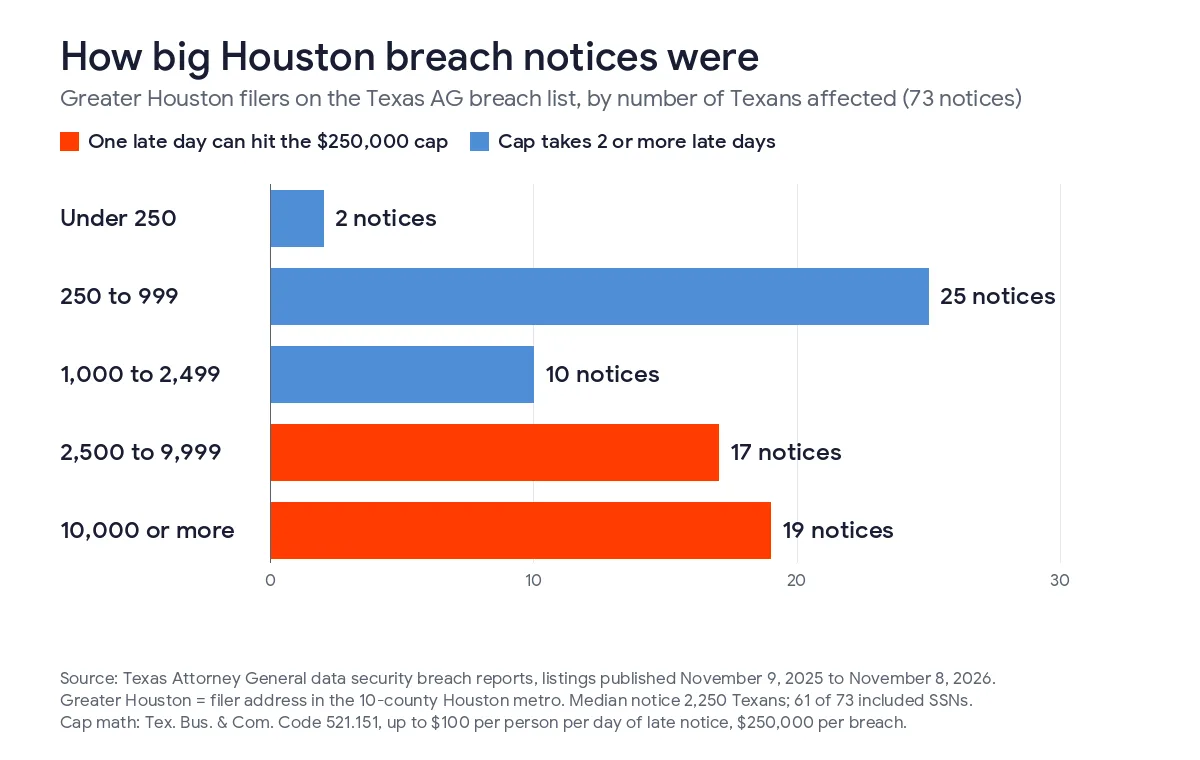
Half the Houston notices were bigger than that. 36 of the 73 covered 2,500 or more Texans, which means a single late day could reach the $250,000 cap on its own, and 61 of the 73 involved Social Security numbers, the kind of record that makes regulators and plaintiffs’ lawyers pay attention. Who you report to, and in what order, is covered in our guide to ransomware reporting rules in Houston.
Is the Ransom Part of the Cost?
Only if you pay it. The FBI’s 2025 Internet Crime Report logged 3,611 ransomware complaints with $32,320,105 in reported losses. That’s about $8,950 per complaint.
The FBI says plainly that this figure doesn’t include lost business, time, wages, files, equipment or third-party remediation, and that many victims report no loss at all, which means it leaves out almost every line in our model. The same report counted more than 1,400 complaints from businesses outside critical infrastructure. Law firms led at 18%. Contractors followed at 17%. Engineering firms came next at 10%. Houston has all three.
Paying also carries legal risk. The Treasury Department’s 2021 OFAC advisory warns that paying a sanctioned group can violate federal sanctions rules, and it treats prompt reporting to law enforcement as a significant mitigating factor if a payment does go wrong. Whether to pay the ransom at all is a decision for you, your counsel and your carrier.
What Lowers the Bill?
Fewer days. Anything that shortens recovery pays for itself fastest. CISA’s #StopRansomware Guide and NIST’s ransomware risk management profile point to the same short list. Here’s how we’d rank it by effect on the bill.
- Keep offline, encrypted backups that a stolen admin account can’t delete, and test a full restore at least twice a year.
- Write down what comes back first, and in what order, so day 1 isn’t spent arguing about priorities.
- Turn on multifactor authentication for email, remote access and every admin account.
- Have someone watching alerts after hours, since the FBI and CISA warned in advisory AA21-243A that ransomware crews favor holidays and weekends.
- Know your cyber policy’s notice window and named vendors before you need them.
The first item moves you from the 25-day row of our table to the 5-day row. For a 50-person firm that’s about $339,000. Our disaster recovery services in Houston are built around restore testing for that reason. If an attack is already underway, start with our checklist for the first hour of a ransomware attack in Houston.
What Does Uprite Charge, and What Don’t We Cover?
Our pricing page lists MSSP Security Focus from $40 per user per month for companies that already run their own IT, and it includes SIEM and SOC monitoring, vulnerability scanning and incident response. 50 users pay $24,000 a year. That’s less than 2 days of idle payroll in our model. Our average first response is 5 minutes.
We don’t do forensics. Forensic imaging, attribution and expert testimony belong with a specialist, ideally the one your carrier already approved. What we handle is containment, account resets and the restore itself, which is where the days go and so where the money goes. Details for local teams are on our managed security services in Houston page.
How Do You Price Your Own Exposure?
- Count the people who couldn’t work if file shares, email and your main application went dark, then multiply by $470 a day.
- Decide honestly how many working days a restore would take, based on the last time you actually tested one.
- Add your gross margin per day, since lost sales aren’t in the payroll figure.
- Count the Texans whose personal data you hold, then multiply by $100 to see your daily penalty exposure under section 521.151.
- Read your cyber policy for the retention, the notice window and the named responder.
Step 2 is the hard one. Most owners we talk to have never timed a full restore, and the first test is usually slower than anyone expected, which is exactly why it’s worth running on a quiet weekend rather than finding out during an attack.
Want your own numbers run against your headcount, backups and policy? We’ll build the model with you and show where the days go.
Get a Free IT AssessmentQuestions Houston Owners Ask About Ransomware Recovery Costs
How much does ransomware recovery cost a small business in Houston?
About $87,000 to $426,000 for a 50-person company by our model, before any ransom or lost sales. The low end assumes clean backups and 5 working days down. The high end assumes a full rebuild over 25 days and notices to more than 10,000 Texans.
What is the biggest cost in a ransomware attack?
Idle payroll, in every scenario we modeled. Staff who cannot work still get paid on schedule, and a loaded Houston employee costs about $470 a day. Payroll made up 81 to 84 percent of each total, well ahead of responders, lawyers and postage combined.
Does cyber insurance pay for ransomware recovery?
Often for part of it, through vendors the carrier picks. Policies commonly cover forensics, breach counsel and notification, minus a retention you pay first. Lost productivity and lost sales depend on the business interruption terms, so read the declarations page and the waiting period before an attack.
What happens if a Texas business notifies customers late?
The state can seek up to 100 dollars per person for each day of delay, capped at 250,000 dollars per breach. The median Houston notice in our pull covered 2,250 Texans, so a single late day comes close to the cap. Individuals must be told within 60 days.
Is paying the ransom cheaper than restoring?
Rarely, once the whole bill is counted. Paying does not stop the downtime, the rebuild or the legal notice duties, and paying a sanctioned group can break federal rules. Restoring from tested backups shortens the days, which is where most of the money goes.
How long does ransomware recovery take?
No federal source publishes a reliable average for small companies, so we plan on 5, 15 and 25 working days. Clean, tested backups put you at the short end. Untested backups, stolen data or a full rebuild push you toward the long end, and each extra day adds payroll.