
Uprite vs Dataprise comes down to scale against proximity. Dataprise is a national MSP in Rockville, Maryland, majority-owned by Trinity Hunt Partners, with 2,500+ clients and a deep disaster recovery bench. Uprite is a 42-person, operator-owned Texas MSP that prints its per-user prices.
Both firms sell the same core work, from the help desk to 24/7 security monitoring, and both have Houston and Dallas addresses. If you’re shopping for managed IT services in Houston, Dallas, or San Antonio, the choice turns on four things. Who owns the company. What the price sheet says. What clients write in reviews. And how each one handles a bad day, which happens to be the area where Dataprise is strongest and where we give it the most credit further down this page.
We rechecked every Dataprise fact on this page against dataprise.com, its own press releases, Trinity Hunt’s portfolio page, Google Maps, and Clutch on October 22, 2026. Some of it changed. We sell managed IT, so read this as a competitor’s account. We’ve tried hard to keep it fair anyway.
Uprite vs Dataprise at a glance
The table covers what each company publishes about itself as of October 2026. Anything a firm doesn’t put in writing is marked that way.
| What you’re comparing | Uprite | Dataprise |
|---|---|---|
| Headquarters | Houston, Texas | Rockville, Maryland |
| Texas offices | Houston (2), Dallas, San Antonio | Houston and Dallas, among 12 listed US offices |
| Size | 42 people | 250 to 999 employees per Clutch, 2,500+ clients, 386,000 devices |
| Ownership | Operator-owned, no private equity sponsor | Majority-owned by Trinity Hunt Partners since January 2020 |
| Recent acquisitions | Trif Technologies, Dallas, August 2026 | 9 announced from July 2021 to October 2024 |
| Published prices | 5 plans, $40 to $138 per user per month | 3 per-user bundles, no dollar figures printed |
| Seat minimum | None printed for Fully Managed IT. IT Pro is for teams of 12+ | None listed on the plans page |
| Disaster recovery | Quarterly restore tests in Fully Managed IT | Veeam-based DRaaS with failover into its own data centers |
| Security credentials listed | SOC 2 Type 1 report (2023) | SOC 2 Type 2 and ISO 27001 named on its about page, among others |
| Google reviews | Houston 4.8 (62), San Antonio 4.9 (43), Southeast Houston 4.3 (12), Dallas none yet | Rockville 3.7 (20), Houston none, Dallas no listing found |
| Clutch | 5.0 from 12 reviews | 4.8 from 31 reviews |
| Best fit | Texas companies that want the price and the engineers in the same state | Multi-state firms and anyone who needs a hosted failover site |
A correction first. An earlier version of this page said Dataprise’s IT Foundation plan carried a 50-user minimum. Its plans page doesn’t list one today. So that claim is gone. We also used to say neither company printed prices, which stopped being true for us once we put our rates on a public pricing page that anyone can read before calling a salesperson.

Who Dataprise is in October 2026
Dataprise was founded in 1995 and still runs its network operations center out of the Rockville headquarters it calls home base since day one. It’s big. Really big. The company says it manages 386,000 devices, supports 260,000 users, and holds more than 750 technical certifications across its staff. Its homepage now pitches it as a provider for small and mid-sized businesses, which is a shift from the CIO-focused wording in its older press releases, and its December 2025 plans launch was aimed squarely at midmarket buyers.
Ownership hasn’t moved. Trinity Hunt Partners, a private equity firm based in Dallas, announced its majority investment on January 6, 2020. Its portfolio page still lists Dataprise as an active Fund V company. Is that a problem? Not by itself. But private equity funds usually plan to sell their holdings at some point. So ask any PE-backed provider what a future sale would mean for your contract.
Then came the buying. Dataprise announced 9 acquisitions between July 2021 and October 2024, according to its own press releases, spread across mobility management, data protection, security, and regional MSPs in places as far apart as Boston, Arizona, and Virginia Beach. Two of them explain its Texas reach. In January 2022 it bought Global Data Vault, a Dallas backup and DRaaS company founded in 2004 that held Platinum status with Veeam. In June 2023 it added RevelSec, a security-first MSP headquartered in Texas. Its press releases show no acquisition since October 2024. Its website still runs a page inviting MSP owners to sell, though.

Dataprise names 7 target industries. Financial services, healthcare, legal, state and local government, manufacturing, nonprofits and associations, and business services. In Texas it lists a Houston office at 1410 Brittmoore Road and a Dallas office at 900 Jackson Street. Both pages promise on-site engineers backed by the national team.
Who Uprite is
Uprite is a Texas managed IT and cybersecurity company with 42 people. We run two offices in Houston, one in Dallas, and one in San Antonio. We serve Fort Worth too. No private equity firm owns any part of us.
We buy companies as well. In August 2026 Uprite acquired Trif Technologies, a Dallas MSP that had served North Dallas since 2000, and kept its engineers and its phone number, so Trif’s clients still call the same people who have supported their accounts for years. No outside investor was involved. So the real gap between the two firms isn’t whether either one has bought a competitor, because both have, but who owns the company afterward and what that owner needs from it.
Our rates sit on our managed IT pricing page. They’re starting prices. Fully Managed IT starts at $138 per user per month. Co-Managed IT is $100, the security-only MSSP plan is $40, and two remote-only plans sit at $110 (IT Pro, for teams of 12 or more outside Houston and San Antonio) and $91 (IT Essentials, for teams under 12). The first-year rate is locked. You can leave inside 120 days if it isn’t working. Our average first response is 5 minutes, measured across every client. It’s an average, not a contract term.
What Dataprise reviews say, and what ours say
Search “dataprise reviews” and most of page one is employee sites like Glassdoor and Indeed. Those are employee reviews. They describe the workplace, not the service. For a buyer, Google and Clutch are better reads, so we pulled both companies from both sites on October 22, 2026.
Clutch is where Dataprise looks best. It holds a 4.8 rating from 31 verified client reviews, with quality and schedule both at 4.8 and cost at 4.7. Reviewers use two words most. Timely and communicative. The most common project size they report is under $50,000. Clutch’s own summary also flags a weak spot, slower responses on standard help desk tickets, and that’s a fair thing to raise when you make your reference calls before signing anything with either company.
Google is thinner. The Rockville headquarters listing shows 3.7 from 20 reviews. Thirteen are 5 stars, but 12 of those 13 date from 2016 to 2019 and most have no text. The two reviews posted in 2026? Both 1 star. One says the techs couldn’t fix things quickly, and the other describes corrupted hard drives and no resolution. Read them yourself. Twenty reviews is a tiny sample for a firm with 2,500 clients. Don’t overread it.
Texas is thinner still. We found a Dataprise listing in Houston at 3831 Golf Drive with no reviews at all, which is a different address from the Brittmoore Road office that Dataprise’s own Houston pages give. No Dallas listing turned up.
Now ours, measured the same way on the same day. Uprite’s Houston profile on Westheimer holds 4.8 from 62 reviews, and San Antonio holds 4.9 from 43. Houston reviewers often name the technician who helped them. Our Southeast Houston profile sits at 4.3 from 12. Its newest review is from 2022. Our Dallas profile has none yet. That’s on us. On Clutch we have 5.0 from 12 reviews, which is fewer than Dataprise’s 31. Neither firm has much review history in Dallas.
Disaster recovery, the area where Dataprise is strongest
Dataprise’s Houston disaster recovery page was on Google’s first page for “disaster recovery services houston” when we checked on October 22, 2026. It earned that. Its DRaaS runs on Veeam, where it holds Platinum Cloud and Service Provider status, and it grew with the Global Data Vault deal in Dallas, which brought in a backup and DRaaS team that had been at it since the company was founded in 2004. The service is still labeled GDV DRaaS on its site. Dataprise documents your network, sets the order your servers come back in, and automates a rebuild of the whole environment at one of its own data centers, so a flooded office or a dead server room doesn’t decide how long you’re down. It runs automated DR tests and health checks. It says recovery lands within hours instead of days.
Need a place to fail over to? That’s a strong offer. We don’t publish a packaged DRaaS product like it. Better to say so plainly.

Ours is narrower and more scheduled. Fully Managed IT includes monitored backups and a restore test every quarter, with written results that show how long each restore took. One copy is immutable and offsite. Another sits outside the Gulf Coast storm track. Standby capacity for the systems you can’t run without gets scoped and priced per system after an assessment, so you aren’t paying for warm servers on every seat when only two or three systems would actually stop the business. Our disaster recovery planning for Houston businesses page lays out the tiers, with a 4-hour target for Tier 1.
Testing frequency is where the bundles split. In Dataprise’s plans, a yearly disaster recovery test is listed in IT Comply, its third tier, and not in IT Foundation, which is where a smaller company would usually start. Quarterly is our default. Its DRaaS product runs its own automated tests, though. Ask which one you’re buying.
One more question for both of us. Backup servers are a favorite ransomware target. CISA’s Known Exploited Vulnerabilities catalog lists 4 flaws in Veeam Backup and Replication as of October 21, 2026. All 4 are marked as used in ransomware campaigns, including CVE-2024-40711. That’s not a knock on Veeam. It’s everywhere. It’s a reason to ask any provider, us included, how many days it took to patch the last one and whether the backup console sits on the same network as everything it’s supposed to protect. Want the longer list? We keep one of questions to ask an MSP about backup.
Set your recovery targets before you talk to either firm. NIST’s SP 800-34 contingency planning guide defines how long a system can stay down and how much data you can afford to lose, and those two numbers drive most of what either provider will quote you for recovery.
Security and compliance in Dallas and Houston
Dataprise sells two security packages. Premier combines managed detection and response with its SOC and a full security program, and it maps to HIPAA, PCI DSS, and NIST, the frameworks a clinic, a card-processing business, or a federal contractor usually gets asked about first. Advanced pairs EDR with SOC monitoring. Its Dallas cybersecurity page describes 24/7 monitoring, backup and recovery, and a Dallas-based team.
On paperwork, Dataprise is ahead. Its about page lists SOC 2 Type 2 and ISO 27001 among its credentials. Our SOC 2 report is Type 1, issued in 2023. We haven’t renewed it. That’s a real gap. If your auditor, your insurer, or a customer contract demands a vendor with a current Type 2 report on file, ask Dataprise for its latest one. If it hands that over, that alone may settle this comparison for you, and you shouldn’t let anyone talk you out of it.
Uprite’s security work runs from the same team that runs your help desk. EDR on every covered device, SIEM log correlation, 24/7 analysts, vulnerability scanning, and incident response. Companies with their own IT staff can buy just that layer for $40 per user per month through our managed security services in Houston, and your IT lead keeps the help desk and the projects while we watch the alerts overnight. The same plan covers Dallas.
Does a 40-person firm even need this? Look at who shows up in Texas breach filings. We pulled the Texas Attorney General’s data breach report list on October 22, 2026. Between January 1 and October 20, 64 organizations based in Greater Houston appeared on it, together notifying 2,160,071 Texans. CenterPoint Energy alone accounted for 1,062,060. The median filer notified about 2,950 people. Twenty-two of the 64 notified fewer than 1,000. That group includes two CPA firms, a tax practice, and a hospice operator. Social Security numbers were involved in 57 of the 64. And among the 53 filers that reported both dates, the median gap between the start of a breach and the day someone noticed it was 56 days.
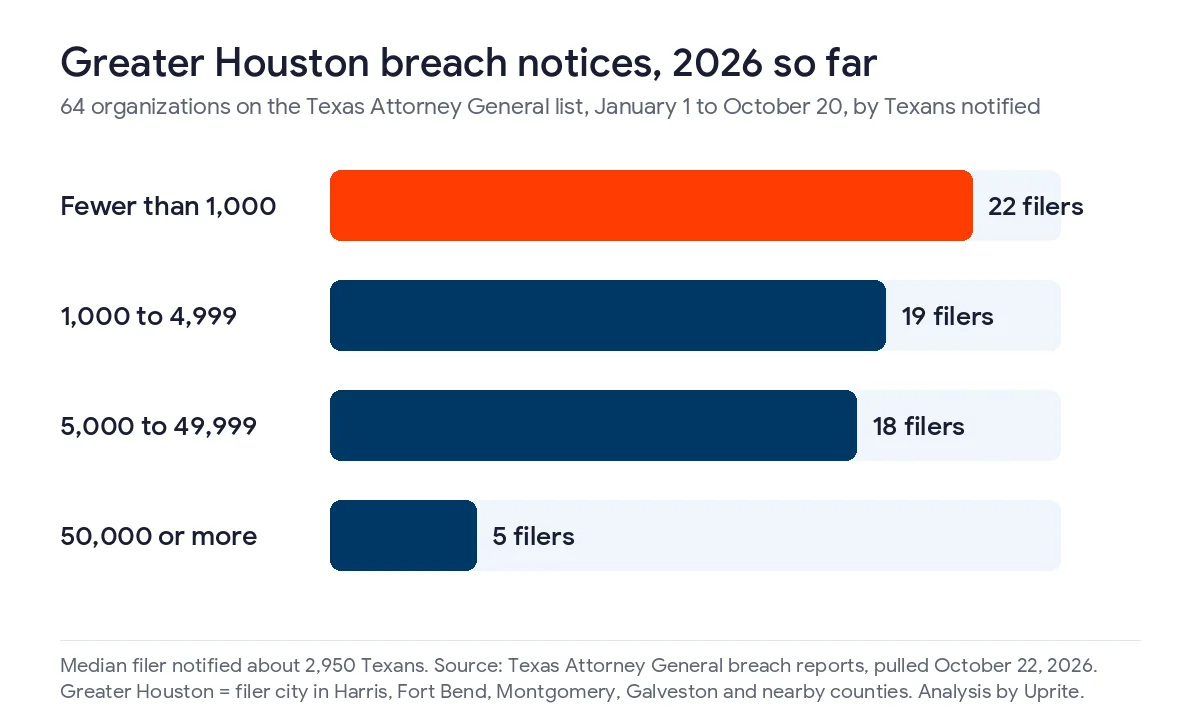
Put that 56 days on the table. Ask each provider how its monitoring would have shortened it. Then ask for an example from a client your size.
Texas law gives you a second reason to keep records. Under Senate Bill 2610, in effect since September 1, 2025, a business with fewer than 250 employees can’t be hit with exemplary damages in a breach lawsuit if, when the breach happened, it kept a cybersecurity program that met a recognized framework at the level its headcount requires. Whoever runs your security should be able to hand you that proof.
Pricing, read the bundle and not the brochure
Dataprise launched its per-user plans in December 2025 and called the pricing transparent, with discounts for multi-year commitments. The plans page lists what’s inside each bundle. No dollar figures, though. To get a number, you fill out its contact form.
The bundles are generous on security. IT Foundation already includes managed backups, endpoint protection, SOC services, security awareness training, and a quarterly vCISO review. IT Fortify adds an enhanced help desk, SIEM, threat hunting, vulnerability scans, an annual penetration test, and a monthly vCISO review. It’s a solid list. IT Comply adds compliance testing, a gap assessment, and that annual DR test.
Ours is printed. A 10-person team on Fully Managed IT pays about $1,380 a month before licensing. That plan carries 24/7 support, on-site and cloud infrastructure, the security stack, a vCIO, and quarterly restore tests. Our cheapest tier has limits, and we print those too. IT Essentials, at $91, is remote only, capped at 8 hours of business-hours support per user per month, and its monitoring raises alerts without anyone responding to them, because it’s built for teams of fewer than 12 people with simple needs.

So how do you compare a printed price against a quote? Line up the tiers. Not the totals. Put Dataprise’s proposal next to ours and check four things, row by row. Who answers a 2 a.m. call. How often a restore gets tested. How many vCISO or vCIO hours you really get. And what the multi-year discount costs you in exit terms, since a multi-year commitment and a 120-day exit are very different promises when service slips.
Where Dataprise is the better choice
Pick Dataprise if your company has offices in several of the states where it runs hubs, say Maryland, New York, and Texas, and you want one provider and one contract covering every one of those locations under the same service desk. Our offices and engineers are all in Texas.
Pick it if you need a hosted failover site. Its DRaaS platform, with automated rebuilds in its own data centers, is something we don’t sell as a packaged product.
Pick it if a customer, auditor, or insurer wants a vendor with a SOC 2 Type 2 report or an ISO 27001 certificate, both of which Dataprise lists on its about page. Pick it for large mobility fleets, which came with its Wireless Watchdogs acquisition. Or for IT due diligence during a merger, which it sells as its own service. Those are real strengths. A firm with 2,500 clients and 17 straight years on the MSP 501 has earned them.
Where Uprite is the better choice
Choose Uprite if your business lives in Texas and you’d rather the owners and the engineers did too. You’ll see the price before the first meeting. The year-one rate won’t rise. And you can walk away inside 120 days, which is a lot less risk than a multi-year term, especially for a 15-person or 40-person company signing its first managed IT contract and still learning what good service looks like.
Choose us if your team already handles IT and wants a co-managed IT partner who works next to them. Or if you’d rather check a local Google review history than a national logo. Or if you’d rather not think about a future change of owner at all. Being operator-owned guarantees nothing. It just takes one variable off the table.
Dataprise alternatives in Texas
Shopping for Dataprise alternatives in Texas? Compare another regional firm. Our Uprite vs Centre Technologies breakdown covers a Houston option, and our comparison with ITECS covers one in Dallas. For a wider field, our ranking of managed IT providers in Dallas scores several firms side by side. Run the same four checks on every shortlist. Ownership, printed price, review history, and restore testing.
Questions buyers ask about Uprite and Dataprise
Does Dataprise still require a 50-user minimum?
Not on its website. As of October 22, 2026, the Dataprise plans page describes IT Foundation, IT Fortify, and IT Comply without a seat minimum or a printed price. An earlier version of this comparison said 50 users. Ask for the minimum in writing before you compare quotes.
Who owns Dataprise?
Trinity Hunt Partners, a Dallas private equity firm, holds a majority stake it announced on January 6, 2020, and still lists Dataprise as an active Fund V company. Dataprise then announced 9 acquisitions, the latest in October 2024. Uprite is operator-owned, with no private equity sponsor.
What do Dataprise reviews say?
Business clients rate Dataprise 4.8 on Clutch from 31 reviews, praising timely and communicative work. Its Rockville Google listing shows 3.7 from 20 reviews, and both reviews posted in 2026 gave 1 star. The Glassdoor and Indeed results for Dataprise are employee reviews, not client reviews.
Which industries does Dataprise work with?
Seven, by its own industry pages. Financial services, healthcare, legal, state and local government, manufacturing, nonprofits and associations, and business services. Uprite publishes Texas industry pages for some of the same sectors, such as financial services and manufacturing, plus construction and oil and gas.
How does Dataprise pricing compare with Uprite pricing?
Dataprise sells per-user bundles with discounts for multi-year terms, but its plans page prints no dollar figures. Uprite prints five starting rates, from $40 per user per month for security-only coverage to $138 for fully managed IT, with the first-year rate locked and a 120-day exit.
Is Dataprise better than Uprite for disaster recovery?
For a hosted failover environment, yes. Dataprise runs a Veeam-based DRaaS platform that it expanded with its 2022 purchase of Global Data Vault. Uprite includes a quarterly restore test in Fully Managed IT and scopes standby capacity per system. Ask both firms for their newest restore test report.
Does Uprite cover Dallas and San Antonio, or only Houston?
All three, plus Fort Worth. Uprite runs offices in Houston, Dallas, and San Antonio with 42 people, and the Dallas team grew in August 2026 when Uprite acquired Trif Technologies. Teams of 12 or more outside Houston and San Antonio can also choose the remote IT Pro plan.
Already holding a Dataprise proposal? Send it over. We’ll price the same scope on our published rates and show you, line by line, where the two differ.
Compare My Dataprise Quote