
Last updated: May 28, 2026
Zero trust is a security framework that assumes no user, device, or network is trustworthy by default and requires continuous verification for every access request. You implement it by identifying sensitive assets, mapping data flows, enforcing least-privilege access, and continuously monitoring every connection.
Zero trust removes automatic trust from your network. You verify every user and device, grant least-privilege access, and assume a breach can happen anywhere. It is a strategy, not a single product. You roll it out in 5 steps, start with your most sensitive data, and build on the security tools you already own.
Zero trust is not a product or a tool, but a mindset and a strategy that you can apply to any organization, regardless of its size, industry, or infrastructure. It pairs naturally with the rest of your cybersecurity solutions, though it does require a shift in culture, processes, and technology. This article walks through the benefits, principles, technologies, and steps for implementing a zero trust security model in your organization.
How Zero Trust Differs From Perimeter Security
Traditional security trusts anyone already inside the network. Zero trust drops that assumption entirely. Here is how the two models compare.
| Factor | Traditional Perimeter Security | Zero Trust |
|---|---|---|
| Default stance | Trusts users inside the network | Trusts no one by default |
| Verification | Once, at the perimeter | Continuous, on every request |
| Access | Broad once a user is inside | Least privilege, tightly scoped |
| Breach assumption | Keep attackers out | Assume breach, limit the blast radius |
| Best fit | Static, on-premises networks | Cloud, hybrid, and remote work |
Benefits of Zero Trust
Zero trust offers several benefits for your organization.
- Enhanced security. By verifying every access request and enforcing granular policies, zero trust prevents unauthorized access, data leakage, and malware infection, and helps you comply with regulatory standards.
- Improved visibility. By collecting and analyzing data from every access point, zero trust gives you a complete view of network activity, user behavior, and security posture so you can respond to threats faster.
- Increased efficiency. By automating the verification and authorization process, zero trust reduces the overhead of managing multiple security tools and improves the user experience.
Principles of Zero Trust
Zero trust is built on a set of principles that guide how you design and implement the framework. They align with NIST Special Publication 800-207, the federal standard that defines zero trust architecture.
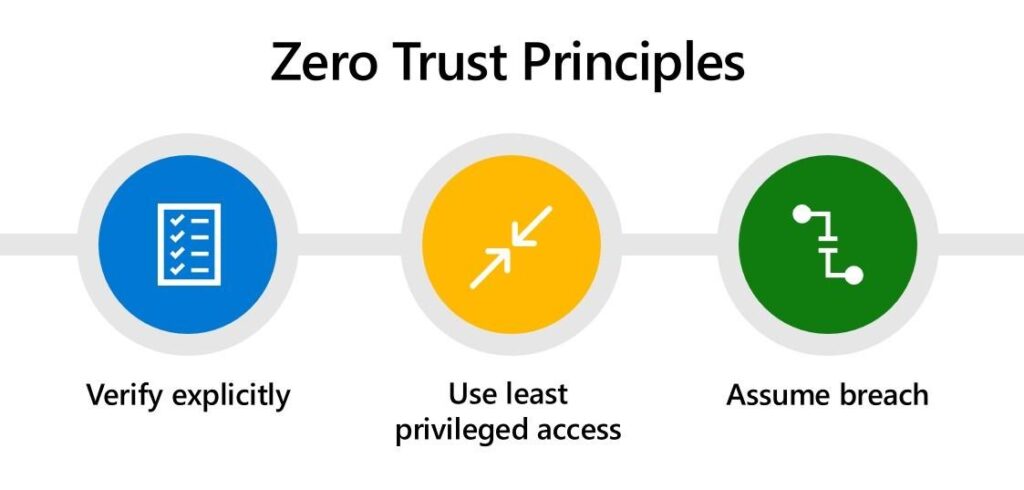
Verify explicitly
Every user, device, and connection should be verified before you grant access, regardless of location, role, or status. Base that verification on multiple factors, such as identity, context, device health, and risk level, backed by multi-factor authentication.
Enforce least privilege
Every user and device should get the minimum access required to do the job, and nothing more. Revoke or adjust that access as soon as the role changes or the task is done.
Assume breach
Treat every connection as a potential threat, and monitor and audit it for suspicious activity. Any sign of compromise should trigger an immediate response and remediation.
Steps to Implement Zero Trust
Implementing zero trust is not a one-time project but a continuous journey of planning, execution, and improvement. If you want a maturity benchmark, the CISA Zero Trust Maturity Model maps these stages across 5 pillars. Here are the steps to implement zero trust in your organization.
Identify sensitive data and assets
Start by identifying where your critical data lives and which digital assets need the highest protection. Knowing what you are protecting is what makes the rest of the zero trust principles work.
Map the transaction flows
Understand how data moves across your organization, and who accesses it, when, where, why, and how. This helps you define the boundaries and segments of your network and the policies that govern them.
Architect your zero trust networks
Design your network around the zero trust principles, using technologies such as micro-segmentation, identity-aware proxies, and software-defined perimeters to isolate sensitive assets. You can learn more about how zero trust networks work, and you should also encrypt data at rest and in transit.
Monitor and maintain security
Monitor and analyze network activity, user behavior, and security posture, and use real-time alerts and dashboards to detect and respond to threats. Audit your policies and controls regularly, and update them as things change.
Continuous improvement
Zero trust is not static. It is a dynamic process that needs constant evaluation and adaptation. Gather feedback from your stakeholders, measure your outcomes, and keep looking for ways to tighten the framework and align it with your business goals.
Zero Trust Technologies and Solutions
To run a zero trust model, you need technologies that verify and authorize every request, enforce policy, encrypt data, and surface threats. These map closely to the pillars in Microsoft’s Zero Trust model. The most common ones are below.

Micro-segmentation
This technique divides your network into smaller, isolated segments, each with its own policies and controls. Micro-segmentation shrinks the attack surface, limits the lateral movement of attackers, and helps you contain a breach.
Identity-aware proxies
These services sit between users and applications and provide secure, context-aware access. Identity-aware proxies verify the identity and context of users, enforce multi-factor authentication, and apply adaptive policies based on risk. Cyber insurers ask about the same access controls, as our list of security controls on a cyber insurance application shows.
Identity and access management
This system manages the identities and access rights of users and devices and provides secure, low-friction authentication and authorization. It verifies identity and device health, grants granular access, and revokes or modifies it as needed.
Data encryption
Encryption transforms data into an unreadable format using a secret key, which blocks unauthorized access or modification. It protects data at rest and in transit and keeps it confidential and intact.
Security monitoring and analytics
This system collects and analyzes data from logs, events, and alerts to give you visibility into network activity, user behavior, and security posture. It helps you detect threats, find vulnerabilities, and improve your results over time.
Zero Trust Best Practices and Tips
These best practices help you design and deploy zero trust effectively and without wasting resources.
Start small and scale up
Here is the honest truth. Most zero trust projects do not stall because of technology. They stall because teams try to secure everything at once and lose momentum. Begin with your most sensitive assets and a single, well-defined segment, then expand your scope based on your needs and priorities.
Align with your business goals and needs
Zero trust is not a one-size-fits-all solution. It should fit your organization’s specific context, so align your model with your industry, size, infrastructure, regulations, and risk appetite. For a leadership view of the trade-offs, see what SMB leadership needs to know about zero trust.
Build on the tools you already have
Zero trust does not mean ripping out and replacing your current tools. You can integrate them into your zero trust model instead. Building on what you already have saves time, money, and effort, and gets more value from the security investments you have already made.
Zero Trust Questions, Answered
What is a zero trust security model?
A zero trust security model treats every user, device, and connection as untrusted until verified. Instead of trusting anything inside the network perimeter, it checks identity, context, and device health for every single access request.
How do you implement zero trust in 5 steps?
You implement zero trust in 5 steps. Identify your sensitive data and assets, map how data flows across your organization, architect segmented zero trust networks, monitor activity in real time, then refine the model continuously as your needs change.
How long does a zero trust implementation take?
Zero trust is a journey, not a one-time project. Most organizations roll it out in phases over several months, starting with their most sensitive assets and expanding as policies and tooling mature.
Is zero trust only for large enterprises?
No. Zero trust applies to any organization regardless of size, industry, or infrastructure. Smaller businesses often move faster because they have fewer systems to segment and secure.
What technologies do you need for zero trust?
Core zero trust technologies include micro-segmentation, identity-aware proxies, identity and access management, data encryption, and security monitoring and analytics. Together they verify access, contain breaches, and give you visibility across the network.
Does zero trust replace your existing security tools?
Usually not. You can integrate zero trust with the tools you already run rather than replacing them, which lowers cost and shortens the rollout while improving your overall security posture.
Ready to Build Zero Trust Into Your Business?
Uprite’s security team designs and deploys zero trust architectures tailored to your environment, from identity and access management to micro-segmentation and continuous monitoring. Talk to an Uprite security expert to scope your zero trust rollout, or call (866) 570-3065.
Conclusion
Zero trust is a security framework that protects your organization from unauthorized access, breaches, and cyberattacks by verifying every access request and enforcing granular policies. It can be challenging to implement, but it pays off in stronger security, better visibility, and tighter efficiency. By partnering with Uprite Services, you get security solutions tailored to your needs and a team that guides you through every step of the rollout. For your next move, read our guide on how to conduct a cybersecurity risk assessment.