Most Houston finance institutions fail IT compliance because they approach it as a single job rather than an ongoing process. Among the most frequent errors are poor documentation, weak access restrictions, inadequate monitoring, and disregard for vendor risk. These gaps increase cybersecurity risk, trigger missed audits, and generate regulatory penalties. These gaps lead to failed audits, regulatory fines, and increased cybersecurity risk. The solution is continuous compliance management, structured documentation, and alignment between IT and leadership.
If you’re running a financial firm in Houston, IT compliance isn’t optional. It’s operational risk. CPA firms comparing providers can start with our ranking of IT support for CPAs in Houston.
And here’s the reality. Most firms think they’re compliant until an audit proves otherwise.
This article is for decision-makers responsible for IT, risk, or operations who need clarity on where things actually break. Not theory. Not checklists. Real gaps that show up in audits.
We’ll break down the 7 most common IT compliance mistakes Houston financial firms make, why they matter, and how to fix them before they impact your business.
Why Is IT Compliance More Complex for Houston Financial Firms
Financial firms operate under overlapping regulatory pressure.
- GLBA Safeguards Rule
- SEC cybersecurity expectations
- FINRA requirements
- FTC enforcement
Financial organizations must create a “comprehensive information security program” intended to safeguard consumer data under the Federal Trade Commission’s GLBA Safeguards Rule (FTC, 2023, U.S.).
Concurrently, the SEC has sharpened attention to disclosure of cybersecurity incidents and reporting rules (SEC, 2023, U.S.).
This creates a layered compliance environment where gaps aren’t always obvious.
What Are IT Compliance Mistakes in Financial Firms
IT compliance mistakes are gaps between regulatory requirements and what your firm can prove through systems, policies, and documentation.
These gaps typically involve:
- Missing controls
- Weak enforcement
- Incomplete documentation
- Lack of monitoring
Auditors don’t evaluate intent. They evaluate evidence.
The 7 IT Compliance Mistakes Houston Financial Firms Make
1. Why Do Firms Treat Compliance as a One-Time Project
Most firms approach compliance annually. That model no longer works.
Environments change constantly:
- Users added or removed
- Systems updated
- Permissions modified
Fix:
- Quarterly compliance reviews
- Continuous monitoring systems
- Ongoing risk assessments
2. What Happens When GLBA Safeguards Rule Is Ignored
The GLBA Safeguards Rule requires structured security programs, not just tools.
Common failures include:
- No written information security program
- No formal risk assessments
- No assigned security owner
Fix:
- Documented security program
- Regular risk assessments
- Assigned leadership accountability
3. Why Weak Access Controls Lead to Compliance Failure
Access control is one of the most audited areas.
Common issues:
- Shared credentials
- No MFA
- Excessive permissions
Fix:
- Enforce MFA
- Role-based access
- 90-day access reviews
4. What Happens Without Audit-Ready Documentation
You might be compliant in practice but fail in proof.
Auditors require:
- Policies
- Logs
- Evidence of enforcement
Without documentation, compliance doesn’t exist.
Fix:
- Centralized documentation systems
- Audit logging
- Policy tracking
5. Why Vendor Risk Is a Hidden Compliance Threat
Third-party vendors expand your risk surface.
Fix:
- Vendor risk assessments
- Security requirements in contracts
- Annual reviews
6. Why lack of surveillance cause belated breach detection
Most businesses miss real-time visibility.
IBM says the average breach detection period is 204 days (IBM Cost of a Data Breach Report, 2023, global).
Fix:
- 24/7 monitoring
- SIEM implementation
- Incident response planning
7. Why IT Alone Cannot Handle Compliance
IT manages infrastructure. Compliance requires governance.
Fix:
- Align IT and compliance leadership
- Conduct regular reviews
- Use external expertise
IT Compliance Self-Assessment Checklist
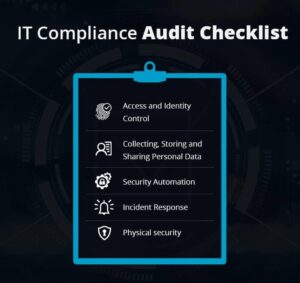
Use this as a quick evaluation.
- Documented security program in place
- MFA is enforced across all systems
- Access reviews every 90 days
- Vendor risk assessments completed annually
- Real-time monitoring implemented
- Incident response plan documented
- Audit evidence available within 24 hours
IT Compliance Risk Impact Table
| Risk Area | Common Gap | Business Impact |
| Access Control | No MFA | Unauthorized access |
| Documentation | Missing logs | Audit failure |
| Vendor Risk | No assessments | Third-party breach |
| Monitoring | No alerts | Delayed response |
| Governance | No ownership | Regulatory penalties |
What Happens When Financial Firms Fail Compliance
The impact is immediate and measurable.
- Regulatory fines
- Audit failures
- Client loss
- Legal exposure
- Reputation damage
According to IBM, the average cost of a data breach reached $4.45M globally in 2023.
How Uprite Helps Houston Financial Firms Stay Compliant
Most firms don’t fail because they lack tools. They fail because compliance isn’t operationalized.
Uprite helps fix that through our IT services for financial firms in Houston.
- Continuous compliance monitoring
- Audit-ready documentation systems
- Risk assessments aligned with financial regulations
- Vendor risk management
- 24/7 security monitoring and response
This isn’t about passing audits once. It’s about staying ready at all times.
FAQ
1. The most frequent IT compliance errors Houston financial institutions commit?
Many companies have problems treating compliance as an annual activity, inadequate access restrictions, missing paperwork, and overlooking vendor risk. Often undetected until audits or incidents reveal them, these IT compliance errors Houston financial institutions make carry regulatory risk and operational disruption.
2. For financial companies in Houston, why is IT compliance more challenging?
Financial institutions have to comply with overlapping rules like those under GLBA, SEC, FINRA, and FTC. In Texas, a documented program built on one of those frameworks can also earn a liability safe harbor under SB 2610. Dallas firms face the same overlapping rules, mapped out in our guide to cybersecurity requirements for Dallas financial services firms. These structures are not always in harmony; compliance is more challenging to oversee. Furthermore, adding pressure to show continuing compliance, client expectations for security evidence keep growing.
3. How usually should financial institutions examine IT compliance systems?
Not once a year, compliance should be evaluated at least once every 90 days. Over time, gaps arise as systems, consumers, and threats always alter. Periodic reviews and ongoing monitoring help to guarantee that controls remain consistent with regulatory expectations and minimize audit surprises.
4. What is the GLBA Safeguards Rule, and what significance does it have?
The GLBA Safeguards Rule demands that businesses have a formal, recorded information security program. It comprises ongoing supervision, given responsibilities, and risk analyses. Often resulting in audit failures, ignoring it is among the most serious IT compliance errors Houston financial institutions commit.
5. Weak access control affects compliance by means of what?
Insufficient access controls, shared accounts, lack of MFA, or excessive permissions raise compliance as well as security concerns. Because they reveal confidential information, auditors note them quickly. Staying compliant calls for effective identity management along with role-based access and frequent reviews.
Takeaway
Most firms don’t fail compliance because it’s complicated.
They fail because they assume they’re covered.
The firms that stay ahead treat compliance like a business function.
That’s the difference.